Punctures & Repairs
Plug vs Patch: Which Puncture Repair Is Safe?
Short answer
The safest permanent puncture repair is a plug-patch combination fitted from inside the tyre, because it seals the inner liner and fills the hole. A plug on its own is a quick roadside fix, and a patch on its own leaves the hole open to moisture.
Key takeaways
- A plug-patch combination (one-piece mushroom repair) is the most reliable permanent fix because it seals the liner and fills the injury channel.
- An external plug is fast and fine to get you moving, but it is fitted blind and the inside of the tyre is never inspected.
- A patch alone seals the air but leaves the hole open, so water and grit can reach the steel belts over time.
- No repair method is acceptable outside the central tread area or for holes wider than about 6 mm.
- Any repair that needs the tyre off the rim should be followed by wheel balancing.
The safest puncture repair is a plug-patch combination: a single unit fitted from inside the tyre that fills the hole and seals the inner liner at the same time. A plug on its own is a quick fix that gets you moving. A patch on its own seals the air but leaves the hole open, which lets water reach the steel belts. If your tyre has a nail in the tread and you plan to keep driving it at motorway speeds, the combination repair is the one to ask for.
I have done thousands of repairs in vans and workshops across Dubai, Sharjah and Abu Dhabi. The difference between the three methods isn’t just theory. I see what happens inside tyres that were repaired the wrong way.
The three repair methods, side by side
| Method | How it’s fitted | Tyre off the rim? | Time on site | Best use |
|---|---|---|---|---|
| External plug (string plug) | Pushed in from outside with an insertion tool | No | 10–15 min | Getting you moving quickly |
| Internal patch only | Glued to the inner liner over the hole | Yes | 30–40 min | Rarely the best choice on its own |
| Plug-patch combination | Stem fills the hole, patch seals the liner, fitted from inside | Yes | 30–40 min | Permanent repair for everyday and highway use |
The external plug
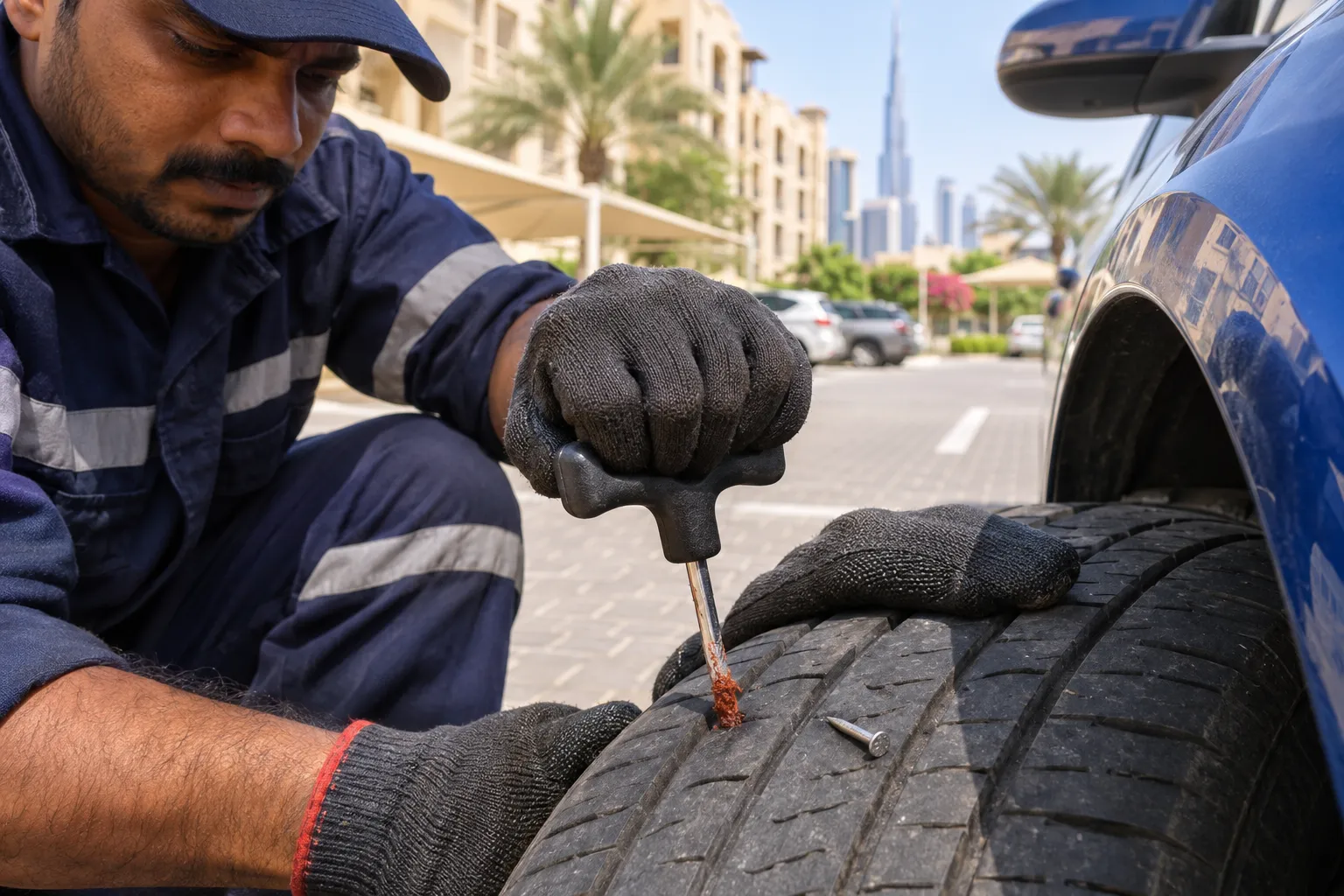
A plug is a strip of sticky rubber-coated cord. I ream the hole, coat the plug in vulcanising cement, push it through with the tool and trim it flush. The tyre stays on the car. It is the repair most roadside shops and petrol station tyre corners do, and it’s what most people think of when they hear “puncture repair”.
The advantage is speed. The weakness is that it’s fitted blind. Nobody looks inside the tyre, so nobody knows whether the nail tore the liner, or whether the tyre was driven low long enough to damage the inner sidewall. The reaming tool also goes through the steel belts at whatever angle the nail went in.
The patch only
A patch is a rubber disc bonded to the inside of the tyre over the hole. The tyre has to come off the rim, the liner is buffed and cleaned, and the patch is stitched down.
It seals the air very well. The problem is the hole itself stays empty. On UAE roads, after a wet morning or a car wash, water and fine sand get pushed into that channel every time the tread hits the road. Steel belts rust. I have cut open patched tyres and found an orange stain spreading along the belt from an old nail hole. That is the start of belt separation.
The plug-patch combination
This is one piece: a rubber stem (the plug part) moulded to a patch. From inside the tyre, I prepare the hole, pull the stem through so it fills the injury, and bond the patch to the buffed liner. The hole is filled, the liner is sealed, and I have looked at the inside of the tyre before committing to the repair.
That inspection is half the value. If I find a ring of rubber dust on the inner sidewall, the tyre was driven flat and is no longer safe, whatever repair you put in it. Our puncture repair service uses combination repairs whenever the tyre comes off the rim.
Why I don’t do plugs on certain tyres
There are cases where I tell the customer a plug alone isn’t good enough:
- High-speed tyres on performance cars. A W- or Y-rated tyre on an AMG or a Porsche spends time well above 120 km/h on the E11 at night. The tyre should be inspected inside, and some tyre makers place conditions on the speed rating after any repair. Ask the manufacturer’s guidance before keeping a repaired tyre on a car used that way.
- Run-flats. Their stiff sidewalls hide the damage from driving deflated. You can’t judge a run-flat from outside. Our page on run-flat tyres explains why they’re handled differently.
- Large holes or angled injuries. If the screw went in at a steep angle, a plug from outside follows that angle and can leave a gap. A combination repair from inside is more controlled.
- Anything near the shoulder. If the hole is close to the edge of the tread, no repair is allowed at all.
The limits that apply to every method
No repair method makes an unrepairable tyre safe. These rules apply whatever kit is used:
- Location. Only the central tread area is repairable. Not the shoulder, not the sidewall.
- Size. Holes up to about 6 mm in diameter. Bigger than that, the steel belts are too damaged.
- Spacing. Repairs must not overlap, and two holes close together usually mean replacement.
- Tread depth. If the tyre is near the 1.6 mm minimum, spending money on a repair makes no sense.
- Driven flat. Inner sidewall damage means the tyre is finished.
If your tyre fails any of these, our tyre replacement service brings a new tyre in the van and fits it on the spot.
What about tyre sealant?
The cans and compressor kits that come with many new cars inject latex sealant through the valve. They can get you off a hard shoulder with a small nail hole. They are not a repair.
They also make my job harder. The sealant coats the inside of the tyre and often the TPMS sensor too. Before I can repair the tyre, it has to be cleaned out, and if the sensor is clogged it may need replacing. If you’ve used sealant, tell the technician so they come prepared.
A real example from the road
A few months ago I had a call from a delivery driver near Dubai Investments Park. His rear tyre had been plugged three weeks earlier at a small shop and was losing air again. When I took the tyre off, the plug was fine, but the nail had been sitting in the tyre for days before it was found. The driver had been topping up the pressure every morning. The inner liner around the hole had separated from the casing in a patch about the size of a coin. An external plug could never have shown that.
Because the separation was small and within the tread area, I could fit a combination repair over a sound section. Two days later on a different call, I wasn’t so lucky. Same story, but the tyre had been run soft on Emirates Road, and the inner sidewall was crumbling. That one went in the scrap pile.
The lesson I took from both: the plug itself rarely fails. What fails is everything nobody looked at.
After the repair: balancing and pressure
Once a tyre has been off the rim, it needs wheel balancing before going back on. A patch adds a small amount of weight, and the tyre may have rotated slightly on the rim. Skip it and you may feel a vibration through the steering at 100 km/h.
Then the tyre goes back to the pressure on the door placard, checked cold. Then I check the other three, because a car that picked up one screw has often picked up two.
Which should you choose?
- Stranded with a nail in the tread? A plug gets you moving safely at normal speeds.
- Planning to keep the tyre for years of motorway driving? Ask for a plug-patch combination.
- Already had a plug and it’s leaking again? Get the tyre off the rim and inspected.
- Hole in the shoulder or sidewall? No method is safe. Replace it.
Price matters too. The combination repair costs more than a quick plug because of the extra labour. I break down the numbers in how much puncture repair costs in Dubai.
When to call us
If there’s a nail in your tyre and you’re not sure how it should be fixed, leave it in place (it is partly sealing the hole) and get in touch. We’ll come to you, inspect the tyre from inside, and tell you honestly whether it can be repaired or needs replacing. Message or call the team through our contact page.
Frequently asked questions
Is a tyre plug a permanent fix?
A properly fitted external plug can hold for the life of the tyre, but it is not considered a full permanent repair because the inside of the tyre is never checked. Treat it as a get-you-going fix and have the tyre inspected from inside when you can.
Is a patch better than a plug?
A patch alone is better at sealing air but worse at protecting the tyre structure, because it leaves the hole empty. The best option combines both in a single plug-patch unit.
Can you drive on the motorway with a plugged tyre?
Many people do, and a good plug in the centre of the tread usually holds. For regular high-speed driving I would still recommend a combination repair, which is inspected and fitted from inside.
How many times can a tyre be repaired?
There is no single number, but repairs must not overlap and should be well apart. If a tyre already has two repairs, or a new hole is close to an old one, it is time to replace it.
Can a sidewall puncture be repaired with a patch?
No. The sidewall flexes constantly and carries the load, so no plug or patch is safe there. A sidewall puncture means a new tyre.
Keep reading
Stuck with a puncture right now?
Send your location on WhatsApp. A technician confirms the price and heads out, usually within 30–45 minutes in central Dubai.