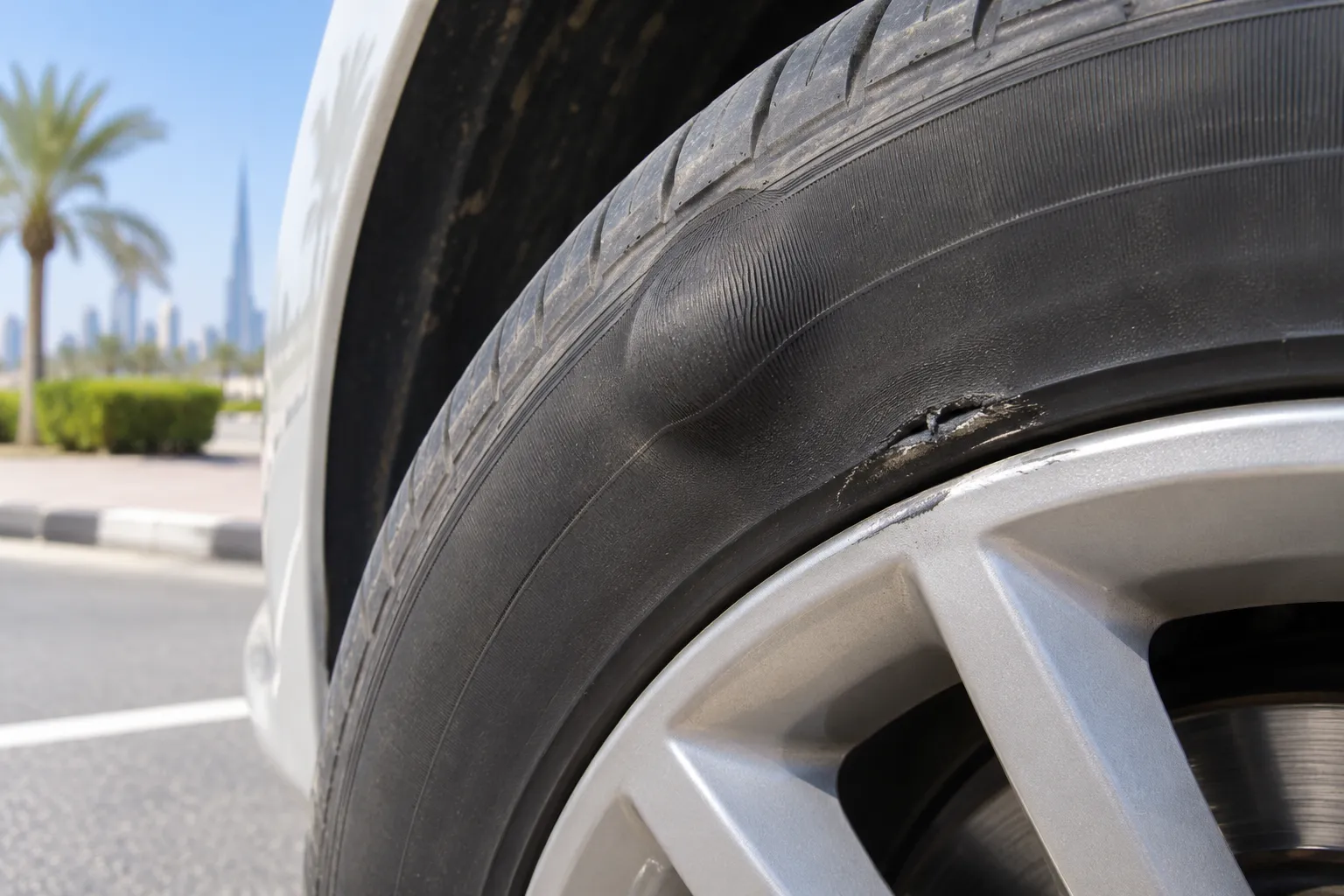
Tyre damage at a glance
| Damage | Where | Repairable? | Urgency | Service |
|---|---|---|---|---|
| Nail or screw in the tread | tread centre | Yes | Book soon | Puncture Repair |
| Over-inflation centre wear | tread centre | No, replace | Book soon | Mobile Tyre Service |
| Chunking from sand and gravel tracks | tread centre | Sometimes | Book soon | Tyre Replacement |
| Puncture in the shoulder | tread shoulder | No, replace | Stop soon | Tyre Replacement |
| Under-inflation wear on both shoulders | tread shoulder | No, replace | Book soon | Tyre Replacement |
| Feathering from misalignment | tread shoulder | No, replace | Book soon | Wheel Alignment |
| Cut or gash in the sidewall | sidewall | No, replace | Stop now | Tyre Replacement |
| Bulge after a kerb strike | sidewall | No, replace | Stop now | Tyre Replacement |
| Impact break from a pothole or speed bump | sidewall | No, replace | Stop soon | Tyre Replacement |
| Heat cracking and dry rot | whole tyre | No, replace | Book soon | New Tyres |
| Overheating from an overloaded tyre | whole tyre | No, replace | Stop soon | Tyre Replacement |
| Cupping from worn suspension | whole tyre | No, replace | Book soon | Wheel Balancing |
| Bead damage from poor fitting | bead | No, replace | Stop soon | Tyre Change & Fitting |
| Leaking valve stem | bead | Yes | Book soon | TPMS Sensor Service |
Diagnosing damage by tyre zone
Start by finding exactly where the damage is. The location decides whether a repair is possible and how urgent the problem is.
| Zone | Common damage | Usually repairable? |
|---|---|---|
| Centre tread | Nails, screws, centre wear, chunking | Punctures up to 6 mm: yes |
| Shoulder | Shoulder punctures, edge wear, feathering | No |
| Sidewall | Cuts, bulges, impact breaks, cracking | No |
| Bead | Fitting damage, rim leaks, valve leaks | Valve leaks: yes. Bead tears: no |
| Whole tyre | Heat damage, overloading, cupping, ageing | No, but the cause must be fixed |
When to stop driving immediately
Some damage means the tyre can fail without warning. If you see any of the following, slow down, pull over somewhere safe and fit the spare or call for help. On a motorway, get as far onto the hard shoulder as you can, put the hazards on and stand behind the barrier. Call 999 if you are in danger.
- A bulge or bubble anywhere on the sidewall.
- Visible cords or steel belts through the rubber.
- A deep cut or gash in the sidewall.
- Heavy vibration, a flapping noise or the smell of hot rubber.
- A tyre that has gone completely flat while driving.
Repairable versus not repairable
A safe permanent repair has to meet three conditions. The damage must be in the central tread area, away from the shoulders. The hole must be no larger than 6 mm. And the tyre must not have been driven flat, because that damages the inner sidewall in ways you cannot see from outside.
The right method is a plug-patch combination fitted from inside after removing the tyre from the rim. A plug pushed in from outside, or tyre sealant, is a temporary fix. Our article on plug vs patch puncture repair explains the difference.
| Damage | Repair? | Why |
|---|---|---|
| Nail in tread, under 6 mm | Yes | Plug-patch seals and fills the hole |
| Two punctures close together | Sometimes | Depends on spacing and maker rules |
| Shoulder puncture | No | Too much flexing for a patch to hold |
| Sidewall cut or bulge | No | Structural cords are broken |
| Driven flat | Usually no | Inner sidewall is often damaged |
| Run-flat after running flat | Usually no | Many makers forbid repair |
Reading uneven wear
Wear patterns tell you about the car as well as the tyre. Worn on both shoulders means under-inflation. Worn in the centre means over-inflation. One edge worn means alignment, usually camber or toe. Patchy scallops mean worn shock absorbers or poor balance.
Fix the cause before fitting new tyres, or the new set will wear the same way. A wheel alignment from AED 99 per car is cheap compared with a new set of tyres.
UAE-specific causes we see most
Construction is everywhere, so screws and nails are the top cause of punctures in Dubai, Sharjah and Abu Dhabi. Mall car parks and basement ramps produce sidewall bulges on low-profile tyres. Summer heat combined with low pressure causes the internal break-ups and blowouts that leave tyre debris on Emirates Road. Desert trips add sidewall cuts, chunking and damage from driving home at sand pressure.
Heat ageing is the quiet one. Cars parked outside year round show cracking within a few years. Our tyre care tips explain how to slow it down.
Frequently asked questions
Can a sidewall puncture be repaired?
No. The sidewall flexes constantly and carries the structural cords, so a patch will not hold safely. A sidewall puncture, cut or bulge means the tyre must be replaced.
What causes a bulge in a tyre?
A bulge forms when an impact, such as a kerb, pothole or speed bump, breaks the cords inside the sidewall. Air pushes the outer rubber out through the gap. The tyre can burst and must be replaced.
Is it safe to drive with a nail in my tyre?
For a short distance, if the tyre is holding air, yes, but get it repaired soon. Leave the nail in place, because it partly seals the hole. If the tyre is losing air fast, stop and fit the spare.
Why are my tyres cracking?
Cracking is caused by heat, UV and age breaking down the rubber. It is common in the UAE on cars parked outside. Light crazing means plan replacement; deep cracks mean replace now.
What causes uneven tyre wear?
Both shoulders worn means under-inflation, centre wear means over-inflation, and one edge worn means misalignment. Cupping points to worn suspension or unbalanced wheels.
How do I know if my tyre is damaged inside?
You often cannot from outside. Signs include vibration, a bulge, rubber dust when the tyre is removed, or a tyre that has been driven flat. A technician needs to take it off the rim to inspect it.
What is the maximum puncture size that can be repaired?
For car tyres, the usual limit is 6 mm in diameter in the central tread area. Larger holes, or any damage in the shoulder or sidewall, mean the tyre should be replaced.
Related pages
- ServicePuncture Repair
- ServiceTyre Replacement
- ServiceWheel Alignment
- ServiceFlat Tyre Assistance
- GuideTyre Puncture Repair Near Me
- GuideRoadside Flat Tyre Help Dubai
- Tyre typeRun-Flat Tyres
- Tyre typeAll-Terrain Tyres
- ArticlePlug vs Patch: Which Puncture Repair Is Safe?
- ArticleCan You Drive on a Flat Tyre? How Far Is Too Far
- ArticleWhy Tyres Burst in UAE Summer (and How to Prevent It)
- Article7 Signs You Need a Wheel Alignment
Stuck with a puncture right now?
Send your location on WhatsApp. A technician confirms the price and heads out, usually within 30–45 minutes in central Dubai.