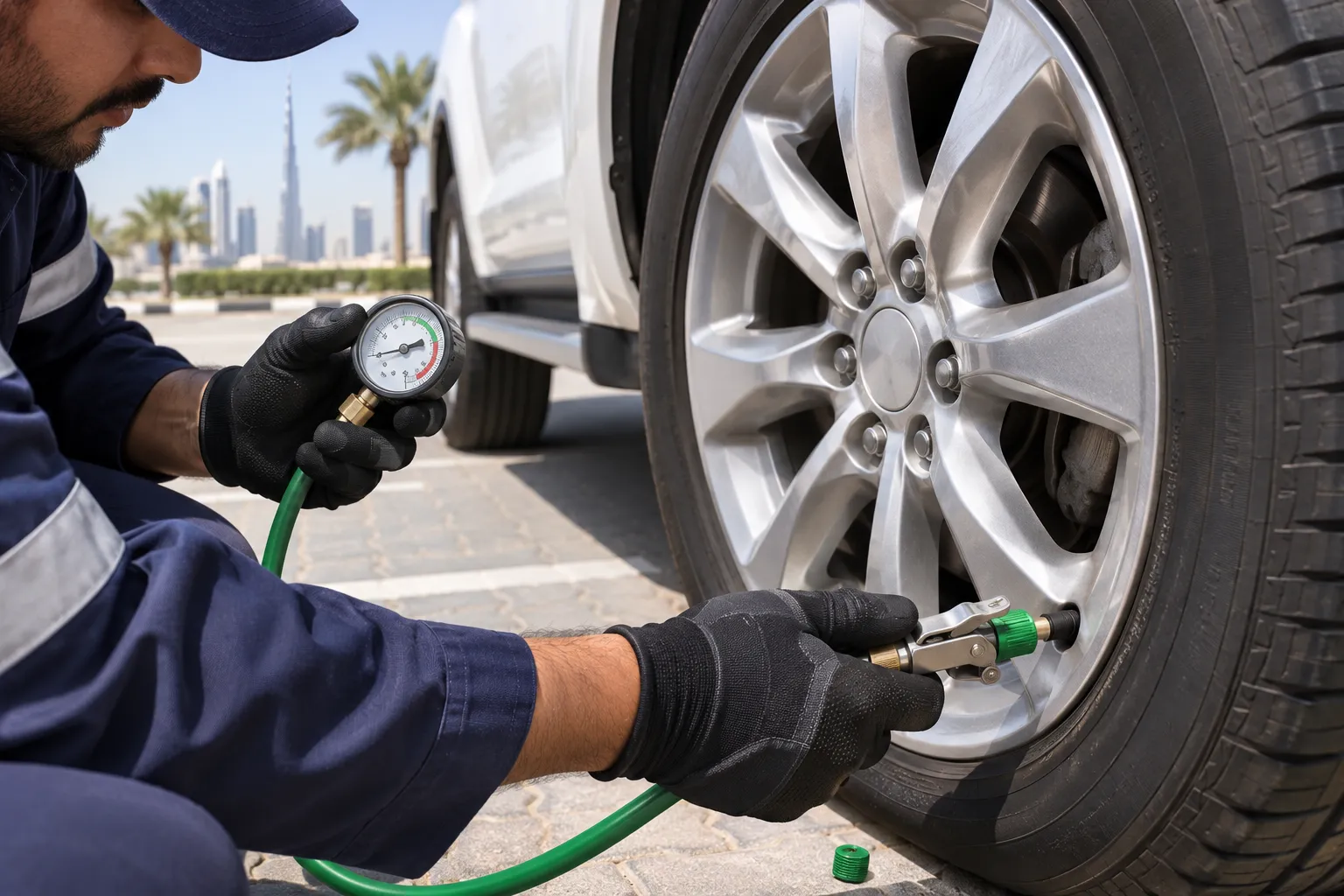
Nitrogen won't make your tyres grip better or last twice as long, whatever some forecourts suggest. What it does do is hold pressure a little more steadily, because nitrogen molecules pass through the rubber more slowly than oxygen and dry nitrogen carries no water vapour. In a climate where cold morning pressure and afternoon pressure on hot asphalt can differ by 4–5 psi, that steadiness has some value.
We fill nitrogen from the van supply at your car. Most people add it when they get new tyres or a tyre replacement, since a fresh tyre is the cleanest moment to start with pure nitrogen.
What the starting price covers
- Nitrogen top-up to placard pressure
- Valve core check for leaks
- Pressure check on all tyres
- Green valve caps to mark nitrogen-filled tyres
What can change the final price
- Full purge-and-fill cycles to raise nitrogen purity in tyres already on air
- Nitrogen-only callout with no other service booked
- Including the spare tyre
- Large SUV tyres that take more gas
- Replacing worn or leaking valve cores
Signs you need nitrogen inflation
- You are fitting new tyres and want to start with nitrogen
- Your tyres lose pressure faster in summer than you would like
- You drive long highway distances at sustained speed
- You cannot check pressures often and want slower loss
- Your tyres already have green caps and need a nitrogen top-up
How we do it, step by step
Time on site: About 15 minutes for four tyres; 25–30 minutes for a full purge-and-fill
- 1
Check current pressures
We measure each tyre cold if possible. If the car has just been driven in the heat, we adjust targets to allow for the temperature.
- 2
Purge the air
For tyres already on air, we deflate to a low pressure and refill with nitrogen, repeating to push the oxygen content down.
- 3
Fill to placard pressure
Each tyre is filled to the pressure on the door placard, not the maximum on the sidewall.
- 4
Fit green caps and test valves
Valves are leak-tested and green caps fitted so future technicians know the tyre is on nitrogen.
Nitrogen versus regular air: the honest numbers
Normal air is already about 78% nitrogen. A good purge-and-fill brings that up to 93–95% or so. The difference is the oxygen and moisture removed, and both of those slowly migrate through the rubber and, in the case of moisture, can corrode steel wheels and sensors from the inside. Studies that compare the two generally show nitrogen-filled tyres losing pressure more slowly over months, not dramatically better handling.
Hassan compares them in nitrogen vs air in tyres, with his view on when it is worth paying for.
| Compressed air | Nitrogen | |
|---|---|---|
| Composition | About 78% nitrogen, 21% oxygen, moisture | Typically 93–95% nitrogen, dry |
| Pressure loss over time | Faster | Slower |
| Pressure swing with heat | Slightly larger with moisture | Slightly smaller |
| Availability | Every petrol station | Tyre shops and our vans |
| Topping up | Anywhere | Air top-up is fine, it just dilutes purity |
When it is worth it and when it is not
Nitrogen makes most sense if you don't check pressures often, if you do long highway runs to Abu Dhabi or Al Ain, or if you have expensive tyres you want to protect. It matters less if you already check pressures every week or two. Either way, nitrogen is not a replacement for checking. A puncture leaks nitrogen as fast as air.
- Worth it: new tyres, long highway mileage, infrequent pressure checks
- Less useful: weekly pressure checkers, short city trips only
- Never a substitute for a UAE summer tyre pressure check
Can you mix nitrogen and air?
Yes, safely. If you are on nitrogen and a tyre is low, topping up with air at the nearest ADNOC, ENOC or Emarat station is perfectly fine. It just lowers the nitrogen percentage. You can come back to us for a purge-and-fill later if you want to restore it.
Pressure, heat and blow-outs
Nitrogen does not prevent blow-outs. Most summer tyre failures in the UAE come from tyres run underinflated, overloaded, old or damaged, which builds heat in the sidewall until it gives up. Correct pressure is what prevents that, whatever gas you use. Our tyre pressure guide has the full explanation, including why you set pressure cold.
Nitrogen Inflation: questions we get asked
How much does nitrogen tyre filling cost in Dubai?
Nitrogen filling starts from AED 10 per tyre when added to another service. A nitrogen-only callout or a full purge-and-fill costs more.
Is nitrogen better than air for tyres in the UAE?
It holds pressure slightly more steadily and carries no moisture, which helps in heat. It does not improve grip or replace regular pressure checks.
Can I put normal air in nitrogen-filled tyres?
Yes. Mixing is completely safe; it only reduces the nitrogen purity. Top up with air if you need to and refill with nitrogen later if you like.
Does nitrogen stop tyres from bursting?
No. Blow-outs are mainly caused by low pressure, overloading, age or damage. Keeping the correct pressure matters far more than the gas.
How often should nitrogen tyres be checked?
At least monthly, the same as air. Nitrogen loses pressure more slowly, but punctures and valve leaks still happen.
What do green valve caps mean?
They mark tyres filled with nitrogen. They are only a reminder and have no technical function.
Nitrogen Inflation near you
Some of the areas we reach every day:
Related pages
- ServiceNew Tyres
- ServiceTPMS Sensor Service
- ServiceMobile Tyre Service
- GuideNitrogen Tyre Filling Dubai
- GuideTyre Shop Dubai
- Tyre typePerformance (UHP) Tyres
- Tyre typeEco & Low Rolling Resistance Tyres
- Tyre typeEV Tyres
- ArticleNitrogen vs Air in Tyres: Worth It in the UAE?
- ArticleCorrect Tyre Pressure for UAE Summer
- ArticleWhy Tyres Burst in UAE Summer (and How to Prevent It)
Book nitrogen inflation now
Send your location on WhatsApp. A technician confirms the price and heads out, usually within 30–45 minutes in central Dubai.