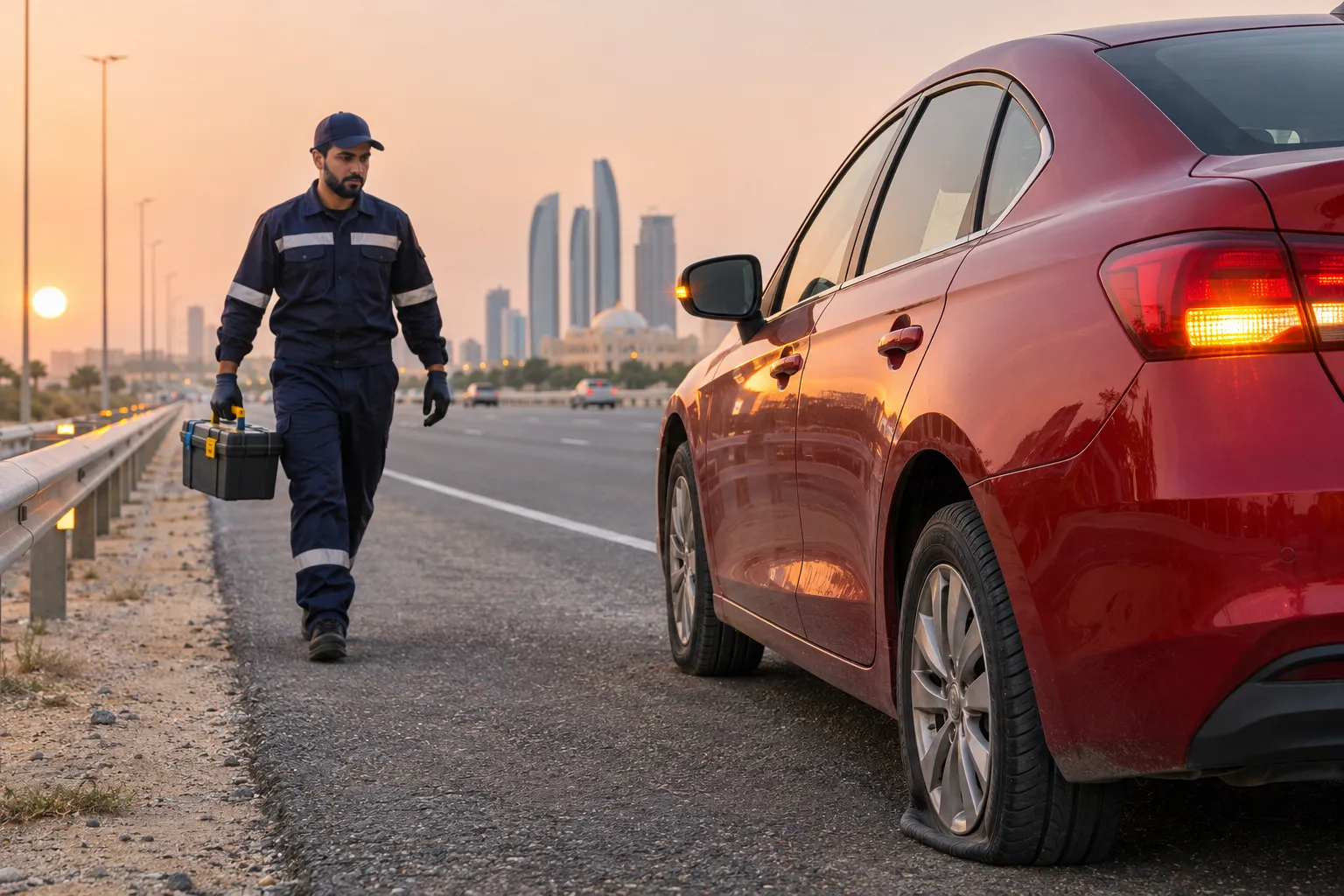
Sheikh Zayed Road carries traffic at 100–120 km/h across up to six lanes in each direction, and the hard shoulder is often narrow. A flat tyre here is less about the tyre and more about not getting hit while you deal with it. Never try to change a wheel on the traffic side of the car.
Our technicians work SZR every day, from the Trade Centre end to Jebel Ali and on towards Abu Dhabi as the E11. This page covers what to do in the first two minutes, how to describe your location, and what we do when we arrive.
The first two minutes: what to do
If the tyre deflates suddenly, grip the wheel firmly, ease off the accelerator and don't brake hard. Let the car slow down, signal and move right towards the hard shoulder.
- Hazard lights on as soon as you feel the tyre go
- Move to the hard shoulder, or take the next exit if it's very close
- If you can't leave the live lane, stay belted in and call 999
- Get all passengers out on the side away from traffic
- Stand behind the barrier, not between the car and traffic
- Place a warning triangle well behind the car only if it's safe to walk there
Hard shoulder or next exit: making the call
A flat tyre can usually be driven very slowly for a short distance without danger, though it may ruin the tyre. If an exit or a petrol station is a few hundred metres away, moving there at walking pace is often safer than stopping on a narrow shoulder. If the shoulder is wide and the exit is far, stop.
Driving further at speed is never worth it. Our guide on how far you can drive on a flat explains why.
Describing where you are on SZR
A live location pin on WhatsApp is ideal. If you can't send one, use these markers so we know the exact side of the road and which way you were heading.
| Marker | Examples |
|---|---|
| Interchange number | 1st Interchange (Trade Centre), 2nd (Al Safa), 3rd (Al Manara), 4th (Al Barsha), 5th (Dubai Marina / JLT) |
| Salik gate | Al Safa, Al Safa South, Al Barsha |
| Landmark | Emirates Towers, Mall of the Emirates, Dubai Internet City, Ibn Battuta Mall |
| Direction | Towards Abu Dhabi / Jebel Ali, or towards Sharjah / Trade Centre |
What our technician does on arrival
The van parks behind your car with warning lights on, as a buffer from traffic. The technician will check that the shoulder is wide enough to work on safely. If it isn't, we may ask you to follow us slowly to the next exit before starting.
Then it's the usual sequence: assess the tyre, repair if it's a simple tread puncture, fit your spare, or replace the tyre from the van. Sudden deflations at highway speed often damage the casing, so a tyre replacement is more common on SZR than on city streets.
Why tyres fail on Sheikh Zayed Road
Most SZR failures we see come from a few causes. Underinflated tyres flex and overheat at sustained high speed, especially in summer when the asphalt reaches 60–70°C. Debris from construction lorries, including bolts and metal strips, ends up in the lanes. And older tyres, five years or more, are more prone to tread separation in the heat.
Checking pressure regularly is the single best prevention; see our page on correct tyre pressure. The detailed walkthrough in Hassan's article on a flat on Sheikh Zayed Road adds real cases from the road.
Beyond Dubai: E11 to Sharjah and Abu Dhabi
SZR continues as the E11, north into Sharjah as Al Ittihad Road and south through Jebel Ali to Abu Dhabi. We cover both ends. Abu Dhabi-bound calls past Ghantoot are handled by our Mussafah van, and Sharjah-bound calls by Industrial Area 4. Arrival takes longer on these stretches, so stay behind the barrier and keep your phone charged. Our flat tyre assistance runs 24/7 on all of them.
Frequently asked questions
What should I do if I get a flat tyre on Sheikh Zayed Road?
Turn on your hazard lights, move to the hard shoulder or the next exit, and get everyone out on the side away from traffic. Stand behind the barrier and call for help. If you're stuck in a live lane, call 999 first.
Should I change the tyre myself on the hard shoulder?
Only if the shoulder is wide and you can work on the side away from traffic. On narrow stretches, it's safer to stay behind the barrier and let a technician with a van and warning lights do it.
When should I call 999 on the highway?
Call 999 if your car is stopped in a live lane, if anyone is injured, or if your position is dangerous to other drivers. Police can manage traffic while help arrives.
How long does it take you to reach Sheikh Zayed Road?
Central sections near Al Quoz and Al Barsha are close to our hub, often 30–45 minutes. Further stretches towards Jebel Ali or Abu Dhabi take longer, depending on traffic.
Can I drive slowly to the next exit on a flat tyre?
For a short distance at very low speed, usually yes, but it may damage the tyre beyond repair. Safety matters more than the tyre.
Why do tyres burst on Sheikh Zayed Road?
The main causes are underinflation at sustained speed, summer heat, debris from construction traffic and old tyres. Regular pressure checks prevent most of them.
Related pages
- ServiceFlat Tyre Assistance
- ServiceSpare Tyre Fitting
- ServiceTyre Replacement
- ServicePuncture Repair
- GuideRoadside Flat Tyre Help Dubai
- GuideEmergency Tyre Replacement Dubai
- GuideTyre Shop Open Now
- Tyre typeTouring Tyres
- Tyre typeSummer Tyres
- BrandMichelin tyres
- BrandContinental tyres
- ArticleFlat Tyre on Sheikh Zayed Road: What to Do
- ArticleWhy Tyres Burst in UAE Summer (and How to Prevent It)
- ArticleCan You Drive on a Flat Tyre? How Far Is Too Far
Stuck with a puncture right now?
Send your location on WhatsApp. A technician confirms the price and heads out, usually within 30–45 minutes in central Dubai.