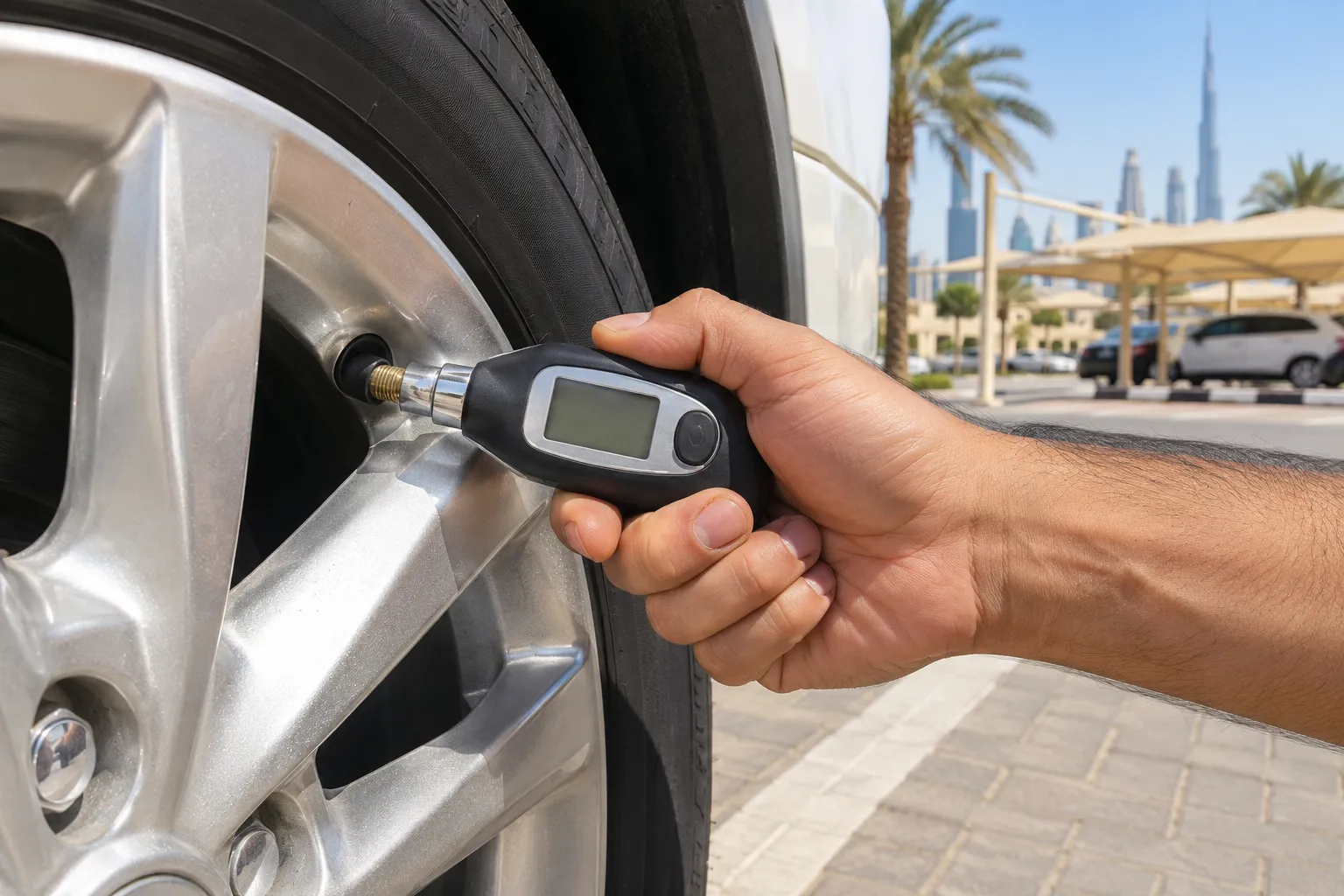
Typical tyre pressures by vehicle
A starting point only. The correct figure for your car is on the placard inside the driver's door.
| Vehicle | Front | Rear | Note |
|---|---|---|---|
| Small hatchback (Yaris, Sunny, Picanto) | 32–35 psi | 30–33 psi | Always use your door placard. Add a few psi when fully loaded if the placard says so. |
| Sedan (Corolla, Civic, Elantra) | 32–36 psi | 32–35 psi | Always use your door placard; figures vary by tyre size. |
| Large sedan (Camry, Altima, Accord) | 33–36 psi | 33–35 psi | Always use your door placard. Some list a higher figure for sustained high speed. |
| Compact SUV (RAV4, CR-V, X-Trail) | 33–36 psi | 33–36 psi | Always use your door placard. Check the loaded figure for family trips. |
| Large SUV / 4x4 (Land Cruiser, Patrol, Tahoe) | 30–35 psi | 32–38 psi | Always use your door placard. Deflate only for sand and re-inflate before tarmac. |
| Pickup (Hilux, Navara, F-150) | 30–35 psi | 35–45 psi | Always use your door placard. Rear pressure rises a lot when carrying a load. |
| Van (Hiace, Urvan, Transit) | 45–55 psi | 50–65 psi | Always use your door placard. C-rated van tyres run high pressures, especially loaded. |
| Sports car (911, AMG GT, Corvette) | 33–38 psi | 35–42 psi | Always use your door placard. Staggered sizes often have different front and rear figures. |
PSI, bar and kPa: reading the units
Pressure is shown in psi (pounds per square inch) on most UAE gauges and forecourt machines. European cars often show bar on the placard and dashboard, and some Asian placards give kPa. They all measure the same thing.
A quick rule: 1 bar is about 14.5 psi, and 100 kPa is 1 bar. So 2.3 bar is roughly 33 psi, and 250 kPa is 2.5 bar or about 36 psi.
| psi | bar | kPa |
|---|---|---|
| 29 | 2.0 | 200 |
| 32 | 2.2 | 220 |
| 33 | 2.3 | 230 |
| 35 | 2.4 | 240 |
| 36 | 2.5 | 250 |
| 38 | 2.6 | 260 |
| 44 | 3.0 | 300 |
Where to find the correct pressure for your car
Look for a sticker on the driver's door pillar (the B-pillar) when the door is open. On some cars it is inside the fuel filler flap or the glovebox. It lists front and rear pressures, often with a second set for full load. The owner's manual has the same figures.
The number moulded into the tyre sidewall ("Max press 51 psi" or similar) is the maximum the tyre can safely hold, not the pressure your car needs. Inflating to that figure gives a hard ride, less grip and centre wear.
- Driver door pillar sticker: the most common location.
- Fuel filler flap: common on European cars.
- Owner's manual: tyre and loading section.
- Some cars show recommended pressures in the infotainment or TPMS menu.
Cold versus hot readings, and the heat effect
Placard pressures are cold pressures, meaning the tyre has not been driven for at least three hours or has done less than a couple of kilometres. As the tyre warms, the air inside expands and the reading rises by roughly 1 psi for every 5–6°C.
On a UAE summer day a tyre can go from 30°C in a basement to 60°C after a highway run, so a 33 psi cold tyre can read 38 psi hot. That is normal and allowed for in the design. If you let air out to bring it back to 33, the tyre will be badly under-inflated once it cools. Check in the morning, before you drive. Our article on the correct tyre pressure for UAE summer has more detail.
Typical tyre pressures by vehicle type
These ranges are typical for UAE-spec cars on their standard tyre sizes. They are a sanity check, not a substitute: always use your door placard, because the same model can have different figures for different wheel sizes.
| Vehicle | Front (cold) | Rear (cold) |
|---|---|---|
| Small hatchback | 32–35 psi | 30–33 psi |
| Sedan | 32–36 psi | 32–35 psi |
| Large sedan | 33–36 psi | 33–35 psi |
| Compact SUV | 33–36 psi | 33–36 psi |
| Large SUV / 4x4 | 30–35 psi | 32–38 psi |
| Pickup | 30–35 psi | 35–45 psi |
| Van | 45–55 psi | 50–65 psi |
| Sports car | 33–38 psi | 35–42 psi |
Desert deflation and re-inflation
For soft sand, letting air out lengthens the tyre footprint so it floats instead of digging. Most UAE desert drivers drop to 15–18 psi for soft dunes like Al Qudra, Big Red or Liwa, and to 20–22 psi for firm sand tracks. Go lower only to recover a stuck vehicle, and only for short, slow distances.
The danger is the drive home. A 4x4 tyre at 16 psi at 100 km/h overheats and can break up inside within a few kilometres. Carry a compressor and re-inflate to the placard pressure before you reach tarmac. Our desert driving tyre pressure guide covers it step by step.
Nitrogen: is it worth it in the UAE?
Nitrogen molecules leak through tyre rubber a little more slowly than oxygen, and dry nitrogen avoids moisture inside the tyre. In practice, a nitrogen-filled tyre holds its pressure slightly longer and shows a little less pressure swing between cold and hot.
It does not replace checking. A nitrogen tyre with a nail in it goes flat just the same. For drivers who forget pressure checks, it helps. You can top up nitrogen with normal air at any time without harm; it simply dilutes the benefit. Read more in nitrogen vs air in tyres.
TPMS: what the warning light is telling you
Tyre pressure monitoring systems either measure pressure directly with a sensor in each wheel, or estimate it indirectly from wheel speed through the ABS. A steady warning light means one or more tyres is significantly low, often around 20–25% below the set pressure. A flashing light that then stays on usually means a system fault, such as a dead sensor battery.
Treat a TPMS warning as real until you have checked all four tyres with a gauge. If the tyres are fine and the light stays on, a sensor may need replacing. Our TPMS sensor service replaces and programs sensors on site.
Frequently asked questions
What is the correct tyre pressure for my car in the UAE?
Use the figure on the placard inside the driver's door, measured cold. Most cars sit between 30 and 36 psi. The same figure applies in summer and winter; heat raises the hot reading, which is normal.
Should I reduce tyre pressure in summer?
No. Set the cold pressure to the placard figure all year. Pressure rises when the tyre is hot, and that is allowed for. Letting air out of a hot tyre leaves it under-inflated, which is the main cause of summer blowouts.
How often should I check tyre pressure?
Every two weeks, and weekly from June to September. Also check before any long trip or desert drive, and whenever the TPMS light comes on.
What is 2.3 bar in psi?
2.3 bar is about 33 psi. To convert, multiply bar by 14.5. For example, 2.5 bar is about 36 psi and 2.0 bar is about 29 psi.
Why is my tyre pressure higher after driving?
Air expands as the tyre heats up, roughly 1 psi for every 5–6°C. After a highway run in summer, readings 3–5 psi above the cold figure are normal. Always set pressure cold.
What tyre pressure should I use for the desert?
Most drivers use 15–18 psi for soft dunes and 20–22 psi for firm sand. Re-inflate to the placard figure before driving on tarmac, because low pressure at speed causes overheating.
Is the pressure on the tyre sidewall the one to use?
No. The sidewall shows the maximum pressure the tyre can hold. Your car needs the lower figure on the door placard. Inflating to the maximum makes the ride harsh and reduces grip.
Related pages
- ServiceNitrogen Inflation
- ServiceTPMS Sensor Service
- ServiceMobile Tyre Service
- GuideNitrogen Tyre Filling Dubai
- Tyre typeAll-Terrain Tyres
- Tyre typeSummer Tyres
- ArticleCorrect Tyre Pressure for UAE Summer
- ArticleDesert Driving: Tyre Pressure and Tyre Choice
- ArticleNitrogen vs Air in Tyres: Worth It in the UAE?
- ArticleTPMS Warning Light: What It Means and What to Do
Stuck with a puncture right now?
Send your location on WhatsApp. A technician confirms the price and heads out, usually within 30–45 minutes in central Dubai.