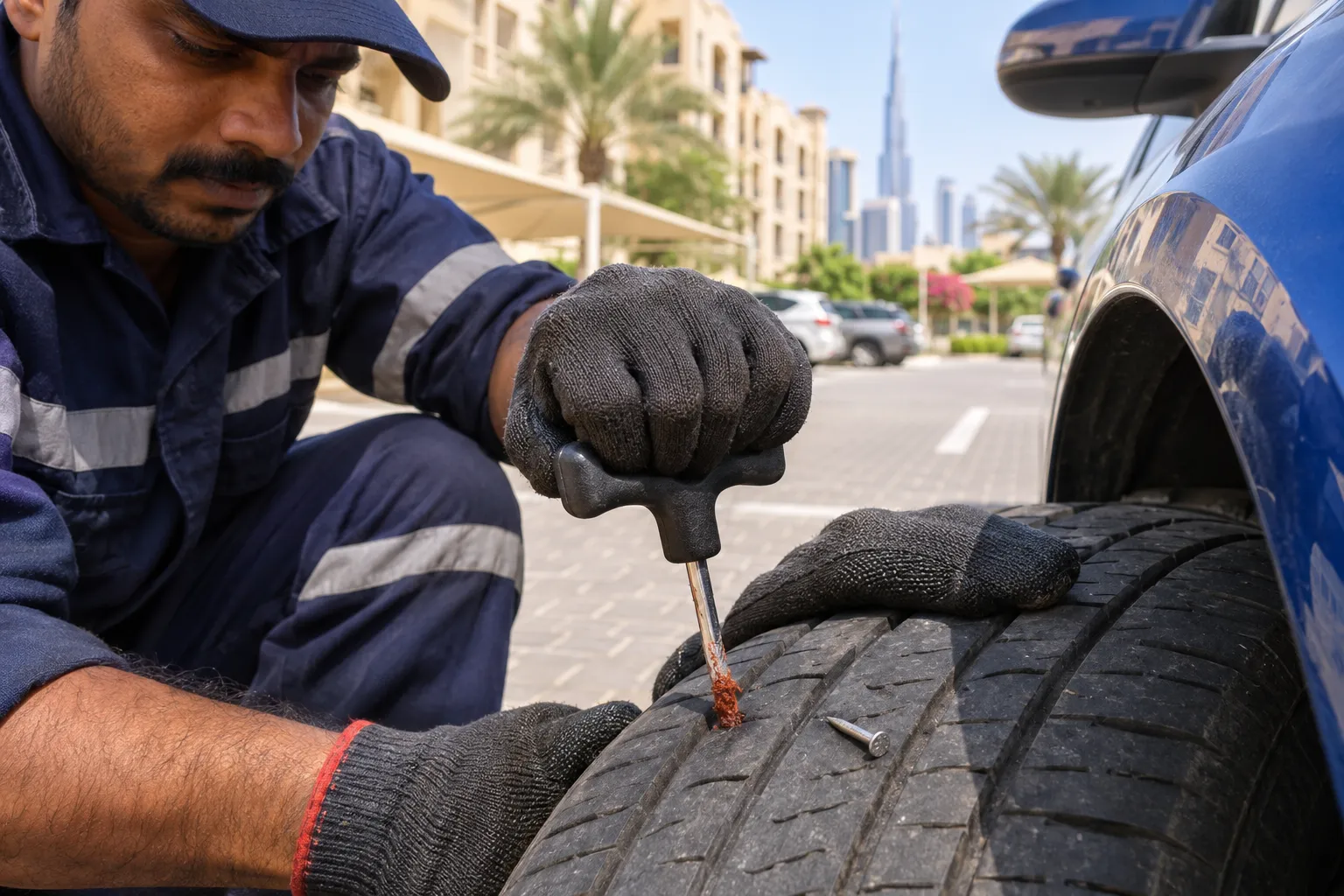
A nail in the tread doesn't have to cost you a new tyre. If the hole is in the central tread area and no wider than 6 mm, our technician can usually repair it properly where your car is parked, It might be a villa driveway in Arabian Ranches, a basement in Business Bay or the hard shoulder of Al Khail Road.
We don't just push a string plug in from the outside and send you off. Every tyre is taken off the rim, checked inside for damage from being driven on low pressure, and repaired from the inside when that's what the hole needs. If the damage is in the shoulder or sidewall, we'll tell you straight and quote a replacement tyre fitted on site instead.
What the starting price covers
- Locating the leak with soapy water and a visual check of the full tread
- Removing the object (nail, screw, metal shard) and cleaning the injury
- Plug repair for small, straight punctures in the central tread
- Re-inflation to the pressure on your door placard
- A final leak test on the valve, bead and repair
What can change the final price
- Plug-patch combination repair from inside the tyre (needs the tyre demounted)
- Run-flat or low-profile tyres, which take longer to remove and refit
- Night callouts and locations outside central Dubai, Sharjah or Abu Dhabi
- Rebalancing the wheel after the tyre has been demounted
- Replacing a perished valve stem or resetting a TPMS warning
- More than one puncture in the same tyre
Signs you need puncture repair
- The TPMS light is on and one tyre reads 4–8 psi lower than the others
- You can see a nail or screw head in the tread
- You keep topping up the same tyre every few days
- A hissing sound when the car is parked with the engine off
- The steering pulls gently to one side on a straight road
- The tyre looks visibly lower than the others first thing in the morning
How we do it, step by step
Time on site: 20–30 minutes on site for a single tyre; 40–50 minutes for an internal patch with rebalancing
- 1
Find the leak
We inflate the tyre, spray it with soapy water and watch for bubbles. Slow leaks often turn out to be the valve or bead, not a nail, and that changes the repair.
- 2
Judge if it can be repaired
We measure the hole and check its position. It must be in the central tread area, no wider than 6 mm, and the tyre must not have been driven flat long enough to damage the inner liner.
- 3
Demount and inspect inside
For anything beyond a clean, straight nail hole, the tyre comes off the rim on the van tyre changer so we can see the inner liner. Rubber dust or a grey ring inside means the casing is damaged.
- 4
Repair the injury
We ream the hole, then fit a plug for small punctures or a plug-patch combination from the inside, which fills the hole and seals the liner in one unit.
- 5
Refit, balance and test
The tyre is remounted, balanced if it was demounted, inflated to your placard pressure and leak-tested again before we torque the wheel nuts.
Plug, patch or new tyre: how we decide
The type of repair depends on where the hole is, how big it is and what the tyre looks like inside. A string plug from the outside is quick and fine for a small, straight nail hole. A plug-patch combination fitted from inside the tyre is the stronger repair and the one most tyre makers recommend, because it seals the inner liner as well as filling the hole.
If you want the long version, our technician Hassan explains the difference in plug vs patch puncture repair. The table below is the short version we use on the roadside.
| What we find | Repair | Why |
|---|---|---|
| Nail or screw in the central tread, under 6 mm, tyre not driven flat | Plug or plug-patch | Inside the repairable zone and the casing is sound |
| Angled screw or hole 4–6 mm in the central tread | Plug-patch combination from inside | An angled path needs sealing from the liner side |
| Hole closer than about 25 mm to the shoulder | Replace tyre | The shoulder flexes too much for a repair to hold |
| Any cut or bulge in the sidewall | Replace tyre | Sidewall repairs are not safe on any car tyre |
| Hole wider than 6 mm or a tear | Replace tyre | Beyond the size a repair can reliably seal |
| Grey ring or rubber dust inside | Replace tyre | Driven flat; the inner sidewall has been crushed |
The 6 mm rule and the repairable zone
Tyre makers and repair-material suppliers set the same basic limit for car tyres: a puncture can be repaired only if it is in the central part of the tread and the injury is no more than 6 mm across. The central zone is roughly the middle three quarters of the tread width, staying clear of the shoulder blocks. Outside that zone, the rubber flexes too much every time the tyre rotates and a repair will eventually work loose.
Two repairs in the same tyre are acceptable if they are well apart, usually at least 40 cm around the circumference, and neither overlaps the other's patch. We also won't repair a tyre that is at or near the 1.6 mm minimum tread depth, because you'd be paying to fix something that needs replacing anyway.
Run-flat and low-profile tyres need extra care
Many BMW, Mini and Mercedes models leave the factory on run-flats. These can be repaired under the same 6 mm rule, but only if the tyre hasn't been driven in run-flat mode at zero pressure. Some makers say a run-flat driven flat must always be replaced. In practice we inspect the inside: if the reinforced sidewall shows heat marks or the liner has blistered, it goes.
Low-profile tyres on 19 inch and larger rims are harder to demount without marking the alloy, so they take longer and fall at the upper end of the price. You can read more on run-flat tyres and why some owners switch to standard tyres with a spare.
Why UAE heat makes a slow puncture worse
On a July afternoon the road surface on Sheikh Zayed Road can sit at 60–70°C. A tyre that is 8 psi down flexes more, builds more heat and is far more likely to fail at speed than the same tyre in a cooler country. That's why we treat a slow puncture as something to fix within a day or two, not something to keep topping up at an ENOC forecourt for a month.
Construction debris is the main culprit here. Screws and roofing nails collect along road edges near building sites in Dubai South, Jumeirah Village Circle and the new Sharjah communities. Keep your pressures right, too: our UAE tyre pressure guide explains why you check them cold, in the morning.
Sealant cans and DIY plug kits
A can of sealant can get you to a safe place, and that's all it is for. The latex coats the inside of the tyre and the TPMS sensor, so tell us if you've used one; we'll need to clean it out before a proper repair, and some sensors don't survive it.
DIY string-plug kits are better than nothing for a small nail hole, but they skip the inside inspection that tells you whether the tyre was damaged by running low. We cover the trade-offs in do tyre sealant kits work.
Puncture Repair: questions we get asked
How much is puncture repair in Dubai?
Our mobile puncture repair starts from AED 49 per tyre. An internal plug-patch, a run-flat tyre or a late-night callout can add to that, and we confirm the full price before we start.
Can a sidewall puncture be repaired?
No. The sidewall flexes constantly and carries much of the load, so no repair will hold safely there. Any cut, puncture or bulge in the sidewall means the tyre needs replacing.
How long does a puncture repair last?
A correctly fitted plug-patch combination in the repairable zone is a permanent repair and should last the remaining life of the tyre. A string plug from the outside is usually fine too, but it is less reliable on angled holes.
Can you repair a run-flat tyre?
Often, yes, if the hole is in the central tread, under 6 mm, and the tyre wasn't driven at zero pressure. We check the inside of the tyre first, and if there is heat damage we will recommend a replacement.
Is it safe to drive with a nail in my tyre?
For a short, slow trip to somewhere safe, usually yes, as long as the pressure is holding. Don't pull the nail out yourself, because it often plugs the hole. Get it repaired within a day or two, especially in summer.
How many times can a tyre be patched?
Most guidance allows two repairs per tyre, provided they are well apart and the patches do not overlap. More than that and we recommend a new tyre.
Do you repair punctures at night?
Yes, our vans run 24/7 across Dubai, Sharjah and Abu Dhabi. A night callout costs a little more than daytime, and we tell you the price on the phone.
Puncture Repair near you
Recent callouts for this service came from:
Related pages
- ServiceFlat Tyre Assistance
- ServiceTyre Replacement
- ServiceWheel Balancing
- ServiceTPMS Sensor Service
- GuideTyre Puncture Repair Near Me
- GuidePuncture Repair Cost Dubai
- GuideTyre Repair Shop Near Me
- Tyre typeRun-Flat Tyres
- Tyre typeTouring Tyres
- Tyre typePerformance (UHP) Tyres
- ArticlePlug vs Patch: Which Puncture Repair Is Safe?
- ArticleHow Much Does Tyre Puncture Repair Cost in Dubai?
- ArticleTyre Sealant and Repair Kits: Do They Work?
Book puncture repair now
Send your location on WhatsApp. A technician confirms the price and heads out, usually within 30–45 minutes in central Dubai.