The tyre pressure warning light is either telling you a tyre is low, or telling you the system has a fault. A solid light usually means low pressure. A light that flashes for about a minute at start-up and then stays on usually means a sensor has failed, most often because its battery has run out after 5–10 years.
We read the sensors with a diagnostic tool before replacing anything, so you don't pay for a sensor you don't need. If a tyre is simply low because of a nail, we'll handle it as a puncture repair and reset the system instead.
What the starting price covers
- Diagnostic scan of all sensors with a TPMS tool
- A programmable aftermarket sensor cloned or coded to your car
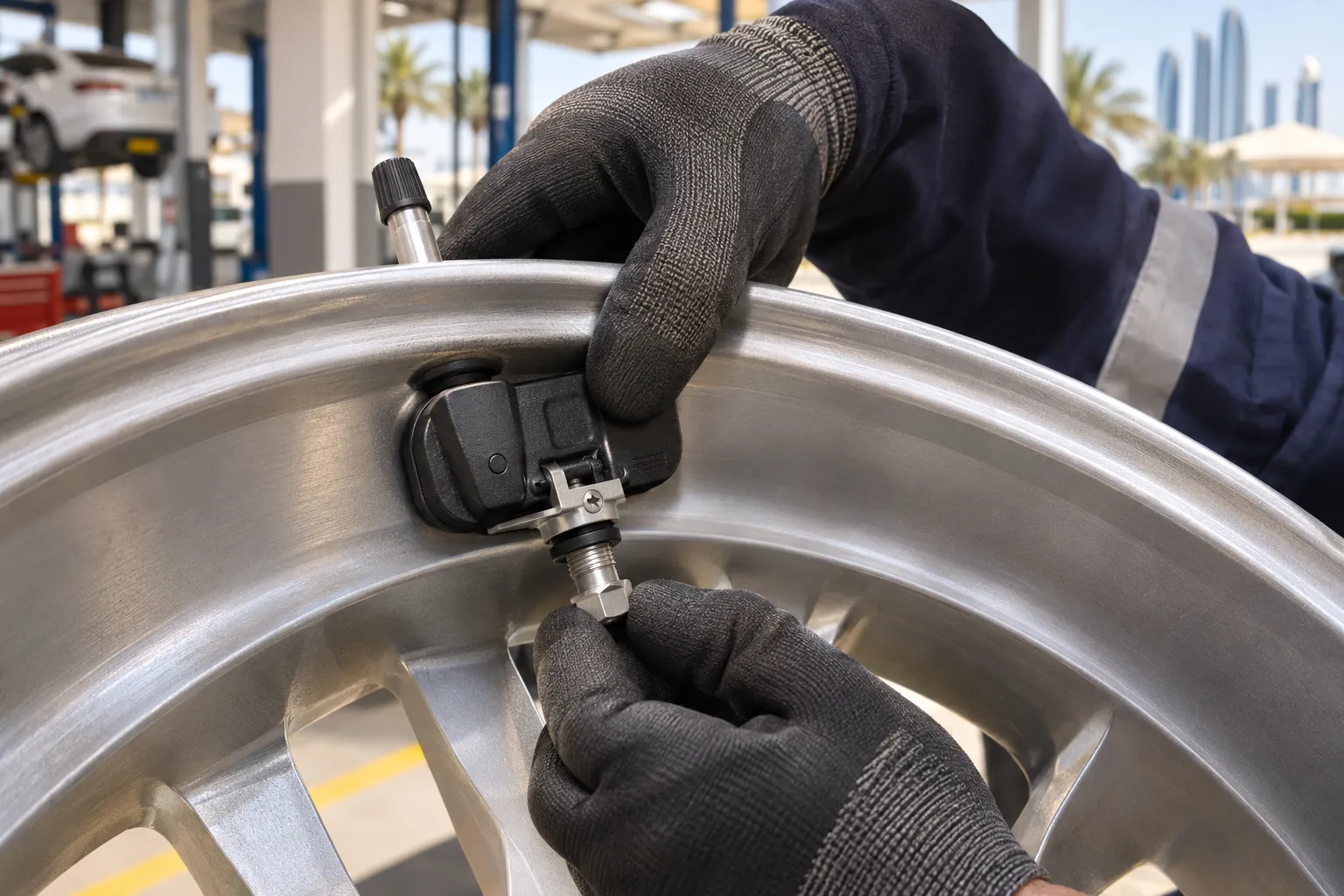
- Demounting the tyre and fitting the sensor with a new seal and nut
- Relearn so the car recognises the new sensor
- Balancing the wheel after the tyre is refitted
What can change the final price
- OEM sensors from the car maker instead of programmable sensors
- Number of sensors replaced (often all four are near end of life together)
- Cars that need an OBD relearn with a scan tool
- Run-flat or low-profile tyres that take longer to demount
- Callout fee and timing
- Corroded valve stems that snap during removal
Signs you need tpms sensor service
- The TPMS light flashes for about a minute at start-up, then stays on
- One tyre shows no reading or dashes on the pressure display
- The warning stays on even though all pressures are correct
- Your car is 6–10 years old and still on its original sensors
- A sensor was damaged during a tyre change elsewhere
- A sealant can was used and the sensor stopped working
How we do it, step by step
Time on site: About 30–45 minutes for one sensor; 90 minutes for all four
- 1
Scan every sensor
We trigger each sensor with a TPMS tool and read its ID, pressure, temperature and battery status. A sensor that does not respond, or shows a low battery, is the one to replace.
- 2
Program the replacement
A programmable sensor is coded for your make and model, or cloned with the old sensor ID so the car accepts it without a relearn.
- 3
Swap the sensor inside the tyre
The tyre is demounted, the old sensor removed, and the new one fitted with a new grommet and nut torqued to spec. Over-tightening cracks the valve.
- 4
Refit and balance
The tyre is remounted and balanced, then inflated to placard pressure.
- 5
Relearn and confirm
We run the relearn your car needs, by drive cycle, tool activation or OBD, and confirm the light is off and all four readings show.
What the TPMS light is telling you
Direct TPMS uses a battery-powered sensor inside each wheel that transmits pressure and temperature to the car. Indirect TPMS has no sensors; it uses the ABS wheel-speed sensors to spot a tyre turning faster than the others, which happens when it is low. Indirect systems only need a reset after you adjust pressures. Direct systems can develop sensor faults that need parts.
Hassan explains the different light patterns in TPMS warning light meaning.
| What you see | Likely cause | What to do |
|---|---|---|
| Solid light, one tyre low on display | Low pressure or puncture | Check and inflate; repair if it drops again |
| Solid light after a hot afternoon or cold morning | Pressure change with temperature | Set pressures cold to the placard |
| Light flashes for about 60 seconds, then stays on | System fault, often a dead sensor | Book a sensor scan |
| No reading from one wheel | Sensor battery dead or sensor damaged | Replace that sensor |
| Light on after rotation or new wheels | Sensor positions not relearned | Relearn procedure |
Sensor battery life and heat
TPMS sensor batteries are sealed in and can't be replaced on their own. Makers quote 5–10 years, but sustained heat inside a tyre rolling on 65°C asphalt drains them at the shorter end. Because all four sensors are usually the same age, when one fails the others are often close behind. If your car is over seven years old and on its original sensors, replacing all four in one visit saves three future callouts.
Programmable or OEM sensors
Programmable aftermarket sensors from established suppliers are coded to work with your specific car and cover most makes, including Toyota, Nissan, Lexus, Hyundai and Kia. They cost less than dealer parts and work just as well when programmed correctly. Some European models, and a few cars with unusual frequencies, are better on OEM sensors, which we can source.
- Programmable: lower cost, wide coverage, coded on site
- Cloned: copies the old ID, so the car needs no relearn
- OEM: exact factory part, higher cost, sometimes needed on European cars
Relearn methods by car
After a new sensor goes in, the car has to learn its ID. Many Toyota and Lexus models need a scan tool or a reset button procedure. Many Nissan and Infiniti models learn after a short drive or a pressure-change sequence. Most European cars use an OBD relearn. If you've had tyre rotation done and the display shows the wrong corner, a relearn fixes that too. For make-specific tyre sizes and fitments, see our Toyota tyre page.
TPMS Sensor Service: questions we get asked
How much does a TPMS sensor cost in Dubai?
Our TPMS sensor replacement starts from AED 149 per sensor, fitted and programmed. OEM sensors and some European cars cost more.
Can I drive with the TPMS light on?
If it's on because a tyre is low, check and inflate it before driving far. If it flashes and stays on, the system is faulty, so it can't warn you of a puncture; drive carefully and check pressures manually until it's fixed.
How long do TPMS sensors last?
Usually 5–10 years, limited by the sealed battery. UAE heat tends to push them towards the shorter end.
Do all four TPMS sensors need replacing at once?
Not necessarily, but they are usually the same age. If one has failed on an older car, the others often follow within a year.
Why is my TPMS light on when the tyres are fine?
Common reasons are a dead sensor battery, a sensor not relearned after rotation or a temperature drop overnight. A diagnostic scan shows which.
How do I reset the TPMS light?
Set all tyres to the placard pressure when cold, then follow the reset in your handbook. If it does not clear or flashes at start-up, a sensor needs checking.
Can tyre sealant damage a TPMS sensor?
Yes. Sealant can block the sensor port and coat its housing. Tell us if you have used it so we can clean or replace the sensor.
TPMS Sensor Service near you
Some of the areas we reach every day:
Related pages
- ServicePuncture Repair
- ServiceTyre Rotation
- ServiceNitrogen Inflation
- ServiceTyre Replacement
- GuideMobile Tyre Service Dubai
- GuideTyre Shop Open Now
- Tyre typeRun-Flat Tyres
- Tyre typeEV Tyres
- ArticleTPMS Warning Light: What It Means and What to Do
- ArticleCorrect Tyre Pressure for UAE Summer
- ArticleTyre Sealant and Repair Kits: Do They Work?
Book tpms sensor service now
Send your location on WhatsApp. A technician confirms the price and heads out, usually within 30–45 minutes in central Dubai.