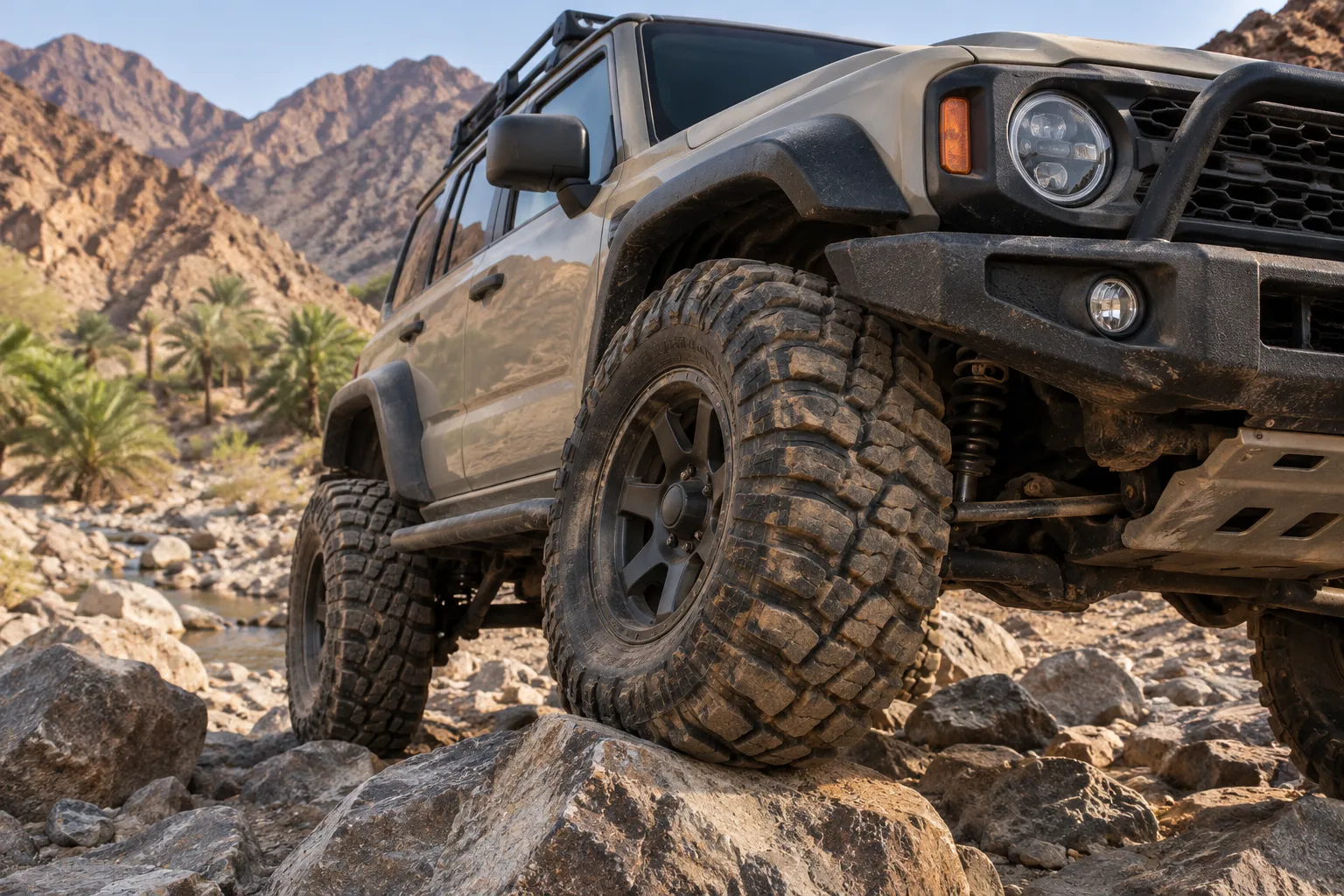
Mud-terrain tyres were developed for places with actual mud, which the UAE has little of. Here they earn their place on rocky wadi floors in Hatta, Ras Al Khaimah and the Hajar mountains, on modified Wranglers, Land Cruiser 70 Series and Patrols with lift kits. Their big shoulder lugs bite on rock ledges and their three-ply sidewalls shrug off cuts that would end an A/T's day.
On sand, M/Ts are a mixed bag. The open tread can dig in if you are heavy on the throttle, and they are heavier to turn. On tarmac they hum loudly, brake longer in the wet and wear faster. If you are deciding between the two, our all-terrain tyres page sets out the trade-offs in detail.
Pros
- Maximum traction on rocks, ruts and loose surfaces.
- Very tough, cut-resistant sidewalls, often three-ply.
- Big shoulder lugs help in deep sand ruts and rock ledges.
- Self-cleaning tread that ejects stones and mud.
Cons
- Loud on the highway, with a noticeable hum from 80 km/h.
- Faster wear and more prone to uneven wear on tarmac.
- Longer wet braking distances and less grip in the rain.
- Heavy, which hurts fuel economy and acceleration.
- Expensive in larger flotation sizes.
Best for
- Modified 4x4s used for wadi bashing and rock crawling
- Expedition vehicles crossing remote areas like the Empty Quarter edge
- Off-road club members who drive off tarmac every weekend
Not ideal for
- Daily commuting on Sheikh Zayed Road or Emirates Road
- Stock SUVs that rarely leave tarmac
- Drivers sensitive to road noise
Our verdict for UAE roads
Most UAE 4x4 owners are better served by an all-terrain tyre. Choose M/Ts only if you regularly tackle rocky wadis or run a modified rig, and accept the noise and wear on your commute. Rotate them every 8,000–10,000 km, because M/Ts develop uneven wear quickly on hot tarmac.
Mud-terrain tyres on UAE terrain: wadis, rock and sand
In Hatta and the RAK mountains, the rocks are sharp limestone and the wadi beds are full of loose stones. That is where an M/T's thick sidewall and big shoulder lugs pay off. In soft dunes, the deeper voids give paddle-like traction but can also dig you in, so smooth throttle and low pressure matter more than tread.
| Terrain | M/T performance | A/T performance |
|---|---|---|
| Rocky wadi floor | Excellent | Good |
| Soft dunes, low pressure | Good | Very good |
| Graded gravel road | Good | Good |
| Wet tarmac | Fair | Good |
| Highway noise | Loud | Moderate |
Running M/Ts at low pressure
The stiffness of an LT M/T means it needs to come down further in pressure before the footprint lengthens, and it recovers more slowly. Many off-roaders run 15–18 psi in dunes and 20–25 psi on rocky trails. Beadlock wheels are sometimes used for very low pressures, but they bring their own legal and maintenance questions.
Re-inflate before any tarmac. A heavy M/T at 15 psi on the highway overheats fast. If you are stuck without a compressor, our mobile tyre service can reach the edge of most desert spots near Dubai, Sharjah and Al Ain.
Wear, noise and rotation on tarmac
M/T tread blocks are tall and independent, so on hot tarmac they flex and wear in a saw-tooth pattern. That increases noise and vibration over time. A five-tyre rotation (including a matching spare) every 8,000–10,000 km spreads the wear. Balancing is also more important on large, heavy tyres; our wheel balancing uses enough weight capacity for 35-inch tyres.
Hybrid and rugged-terrain alternatives
Between A/T and M/T sits the rugged-terrain (R/T) or hybrid category, such as the Nitto Ridge Grappler, Toyo Open Country R/T or Falken Wildpeak R/T. They look aggressive and have tougher shoulders than an A/T, but are quieter and longer-lasting than a full M/T. For many UAE weekend off-roaders, they are the sweet spot.
Popular mud-terrain tyres in the UAE
- BFGoodrich Mud-Terrain T/A KM3
- Nitto Trail Grappler M/T
- Toyo Open Country M/T
- Maxxis Razr MT-772
- Cooper Discoverer STT Pro
- Yokohama Geolandar M/T G003
Frequently asked questions
Are mud terrain tyres good on sand?
They work, but they are not the best. Their deep voids can dig in if you spin the wheels. Run low pressure, around 15–18 psi, and use smooth throttle. Many UAE dune drivers prefer A/T tyres.
Are mud terrain tyres good for daily driving?
They are usable but compromised. Expect more noise, longer wet braking and faster wear. If most of your driving is on the road, an all-terrain or rugged-terrain tyre is a better choice.
How long do mud terrain tyres last?
Most M/Ts last 40,000 to 60,000 km with regular rotation. Hot tarmac and heavy vehicles shorten that, and uneven wear can make them noisy well before the tread is gone.
Can a mud terrain tyre be repaired?
A puncture in the tread area can usually be repaired with a plug-patch combination if the hole is no larger than 6 mm. Sidewall cuts from rocks cannot be repaired safely, even on a thick three-ply sidewall.
What is the difference between M/T and R/T tyres?
R/T (rugged-terrain) tyres are a hybrid between A/T and M/T. They have tougher shoulders and a more aggressive look than an A/T, but are quieter and last longer than a full mud-terrain.
Related pages
- ServiceNew Tyres
- ServiceWheel Balancing
- ServiceTyre Rotation
- ServiceMobile Tyre Service
- Guide4x4 & SUV Tyres Dubai
- Tyre typeAll-Terrain Tyres
- Tyre typeHighway-Terrain Tyres
- BrandBFGoodrich tyres
- BrandNitto tyres
- BrandToyo tyres
- BrandMaxxis tyres
- BrandCooper tyres
- ArticleDesert Driving: Tyre Pressure and Tyre Choice
- ArticleHow to Choose the Right Tyres for Your SUV
Need mud-terrain tyres fitted?
Send us your tyre size and we'll quote stock options from several brands, fitted at your home or office.