If the steering wheel starts to shimmy at around 100 km/h on Sheikh Mohammed Bin Zayed Road and smooths out again at 130, the most likely cause is an out-of-balance front wheel. It's one of the cheapest tyre problems to fix and one of the most commonly ignored.
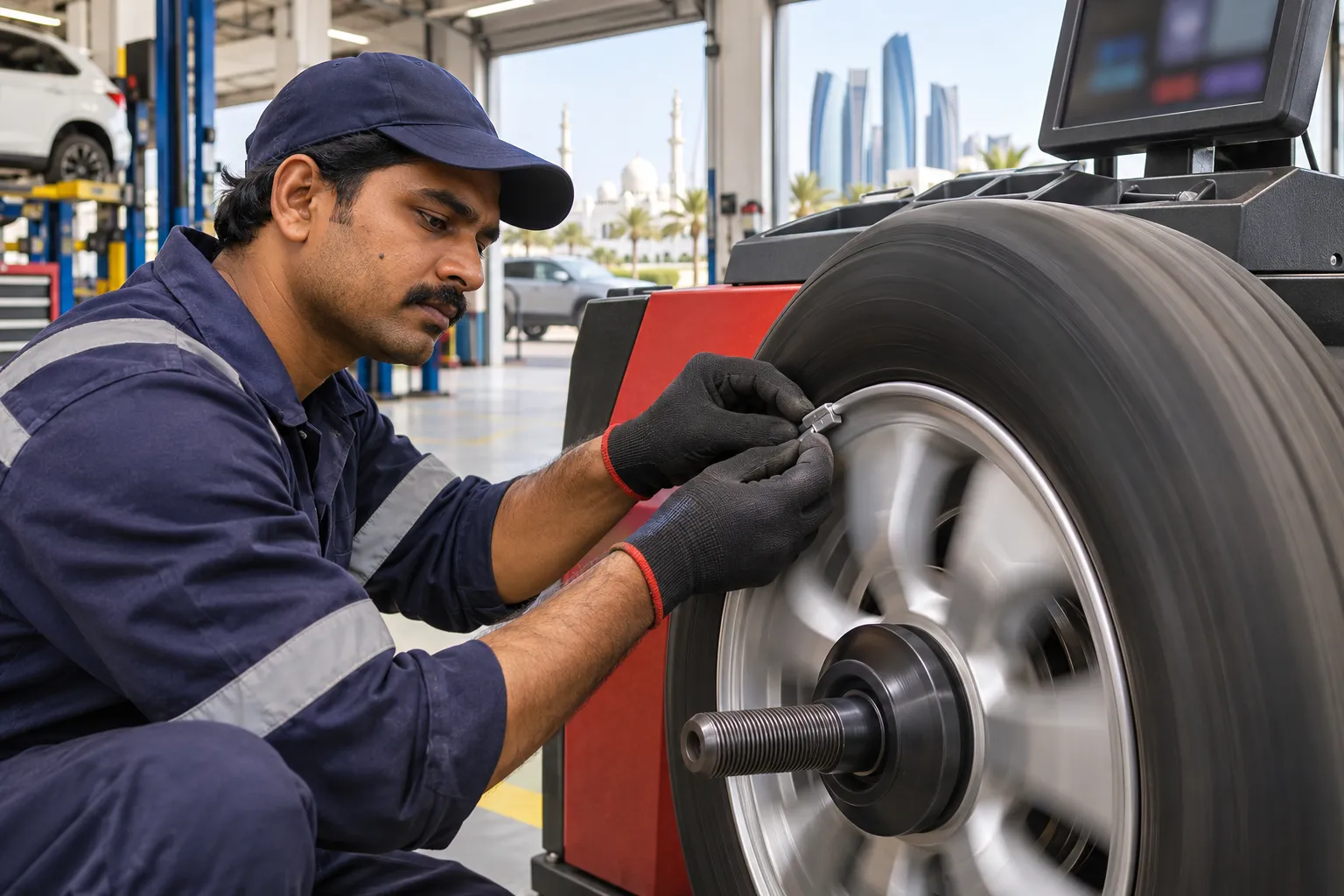
Our vans carry a computerised wheel balancer, so we can balance your wheels at home or at work. We also balance every tyre we fit as part of tyre replacement, because a new tyre is almost never perfectly balanced on the rim straight out of the wrapper.
What the starting price covers
- Removing and refitting the wheel
- Cleaning old weights and dirt from the rim
- Spin balancing for static and dynamic imbalance
- New clip-on or adhesive weights as needed
What can change the final price
- Wheel size: 19 inch and larger take longer on the balancer
- Adhesive weights for alloy rims that cannot take clip-on weights
- Road-force style rematching of tyre to rim for stubborn vibration
- Callout fee if balancing is the only job
- Night and out-of-town callouts
Signs you need wheel balancing
- Vibration through the steering wheel at 90–120 km/h
- Vibration in the seat or floor (often a rear wheel)
- Scalloped or cupped wear patches around the tread
- A new tyre has just been fitted or a tyre was repaired off the rim
- You hit a pothole or kerb hard and a weight may have come off
- A clean patch on the rim where a weight used to be
How we do it, step by step
Time on site: About 10 minutes per wheel; 40–45 minutes for all four
- 1
Remove and clean
The wheel is taken off and the rim cleaned, including the inside barrel where adhesive weights go. Stones stuck in the tread are removed because they skew the reading.
- 2
Mount on the balancer
The wheel is centred on the shaft using the correct cone for the hub bore. Poor centring is the most common cause of a bad balance.
- 3
Spin and measure
The machine spins the wheel and shows how much weight is needed and where, on the inner and outer planes.
- 4
Apply weights and re-check
Weights are fitted at the exact positions shown, then the wheel is spun again until it reads zero or within a few grams.
Balancing or alignment: which do you need?
People often book one when they need the other. Balancing deals with weight spread around the wheel, so its symptom is vibration. Alignment deals with the angle the wheels point at, so its symptoms are pulling and uneven wear. If you have both, start with balancing because it is quicker and cheaper, then book a wheel alignment if the pull remains.
| Wheel balancing | Wheel alignment | |
|---|---|---|
| What it fixes | Uneven weight around the wheel and tyre | Wheel angles: toe, camber, caster |
| Main symptom | Vibration at certain speeds | Car pulls; steering wheel off-centre |
| Tyre wear pattern | Cupping or scalloping | Feathering or one edge worn |
| Where it is done | At your car, on our van | Workshop rig |
| Starting price | From AED 25 per wheel | From AED 99 per car |
Static and dynamic imbalance, simply put
Static imbalance is a heavy spot that makes the wheel hop up and down. Dynamic imbalance is weight off-centre across the width, which makes it wobble side to side. A modern balancer measures both and tells us how much weight to place on the inner and outer edge of the rim. On most cars we're adding between 10 and 60 grams per wheel.
Clip-on weights hook onto the rim lip and suit steel wheels and some alloys. Adhesive weights stick inside the barrel and are used on most alloys so the outer face stays clean.
When balancing does not cure the vibration
If a correctly balanced wheel still vibrates, the cause is elsewhere. Common ones in the UAE are a bent alloy from a pothole or a speed-bump hit, a tyre with a separated belt (often after being run low in the heat), a flat spot from a car that has stood still for weeks during summer travel, or worn suspension bushes. We check the rim for run-out on the balancer and look for bulges in the tyre while it spins.
- Bent rim lip from a kerb or pothole
- Belt separation causing a lump in the tread
- Flat spots after long periods parked
- Worn wheel bearings, ball joints or bushes
- Hub-centric rings missing on aftermarket wheels
How often to balance
Balance whenever a tyre comes off the rim, whenever you notice a new vibration, and as a check every 10,000 km or so. Combining it with tyre rotation every 8,000–10,000 km makes sense, because the wheels are off the car anyway. For more on how wear and balance affect grip and fuel use, see our tyre performance guide.
Wheel Balancing: questions we get asked
How much does wheel balancing cost in Dubai?
Our mobile wheel balancing starts from AED 25 per wheel. A callout fee applies if balancing is the only job, and big SUV wheels can cost a little more.
What are the signs my wheels need balancing?
Vibration in the steering wheel at highway speeds is the classic sign. Vibration in the seat, cupped tyre wear and a missing weight mark on the rim are others.
Is wheel balancing the same as alignment?
No. Balancing corrects weight distribution and cures vibration. Alignment adjusts wheel angles and cures pulling and uneven wear.
How often should wheels be balanced?
Every time a tyre is fitted or repaired off the rim, and roughly every 10,000 km or when you feel vibration. It pairs well with tyre rotation.
Can a balancing weight fall off?
Yes. Clip-on weights can be knocked off by kerbs, and adhesive weights can loosen in extreme heat or after a pressure wash. A sudden new vibration often means a lost weight.
Can you balance wheels without a workshop?
Yes. Every van carries a computerised balancer, so we can balance at your home or office.
Wheel Balancing near you
Recent callouts for this service came from:
Related pages
Book wheel balancing now
Send your location on WhatsApp. A technician confirms the price and heads out, usually within 30–45 minutes in central Dubai.