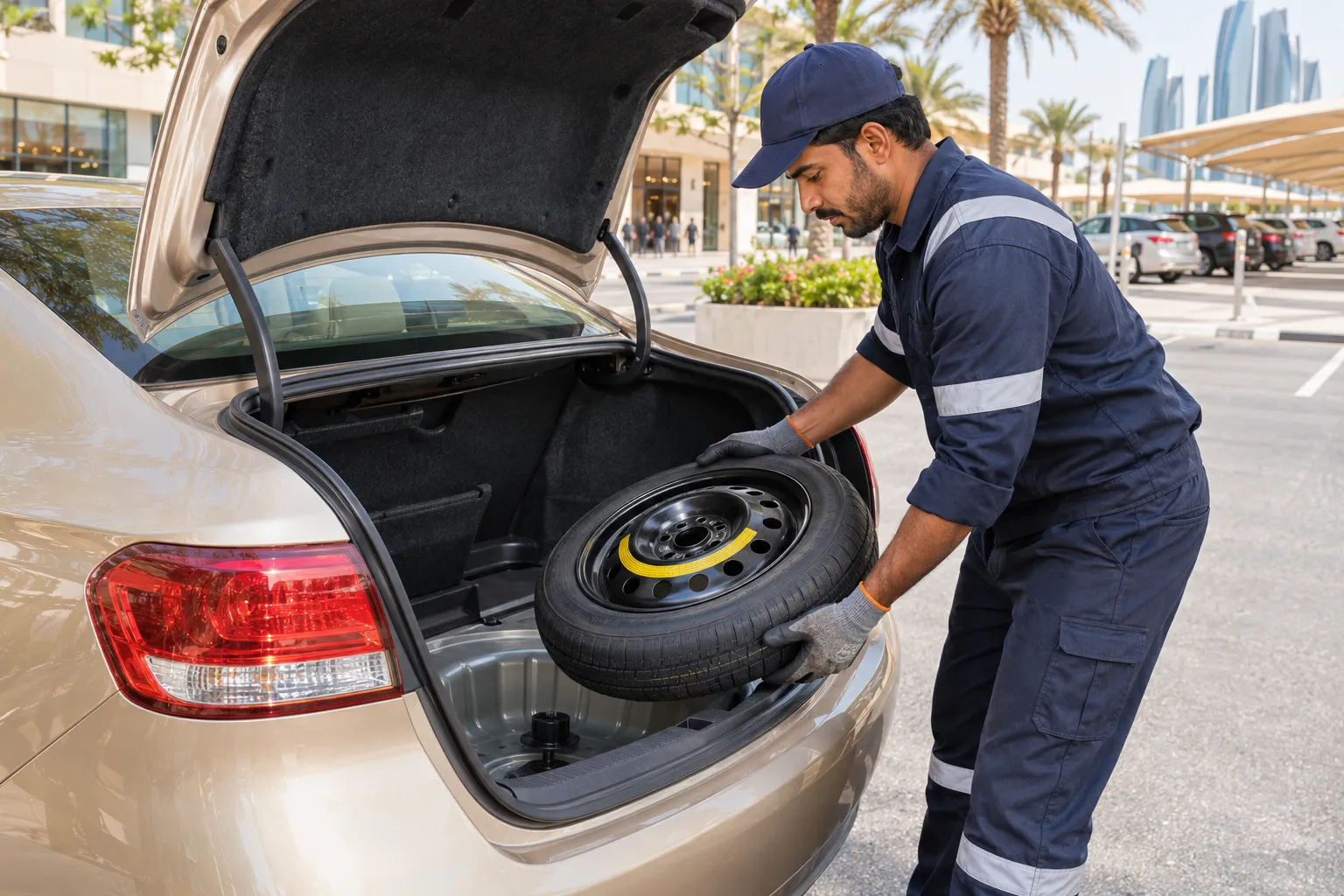
Changing to the spare sounds simple until the jack is missing, the wheel nuts won't move and the spare turns out to be half flat. Most of the spare-wheel callouts we get start with someone who tried for twenty minutes in a car park at Dubai Mall or Mall of the Emirates and gave up.
We fit the spare, check it properly and put the damaged tyre in your boot. If you want the flat fixed at the same time, our technician can carry out a puncture repair on site so you can put the original wheel back on straight away.
What the starting price covers
- Technician visit to your location
- Removing the damaged wheel and fitting your spare
- Inflating the spare to the correct pressure (space-savers often need 60 psi)
- Visual check of the spare for cracks, age and tread
- Stowing the damaged wheel securely
What can change the final price
- Repairing the flat on site and refitting it
- A new tyre if the flat cannot be repaired
- Locked wheel nuts without the key, or corroded nuts
- Night callouts and locations outside the city
- Spare that needs a new valve or is itself unusable
Signs you need spare tyre fitting
- You have a flat and your car carries a spare, but you cannot or do not want to change it
- The jack or wheel brace is missing from the boot
- The wheel nuts are too tight to undo by hand
- You are in a basement or car park where there is little room
- You want your spare checked before a long trip to Oman or Liwa
How we do it, step by step
Time on site: 15–20 minutes on site to fit the spare; add 20–30 minutes if we repair the flat too
- 1
Check the spare first
Before the flat comes off, we pull out the spare and check its pressure and condition. There is no point fitting a spare that is also flat.
- 2
Loosen, lift, remove
Nuts are cracked loose on the ground, then the car is lifted at the correct jacking point with our trolley jack, not the scissor jack.
- 3
Fit and torque
The spare goes on, nuts are snugged in a star pattern, the car is lowered and every nut is torqued to spec.
- 4
Set pressure and brief you
We set the spare to the pressure printed on it or in your manual and tell you the speed and distance limits for that type of spare.
Space-saver, full-size or run-flat car with no spare
A space-saver is narrower and lighter than your normal wheel, and it usually carries a sticker limiting you to 80 km/h. It is fine to get you home or to a repair, but it shifts braking and handling, and on many cars it disables traction control warnings or confuses the ABS. Do not use it on the highway for longer than you have to.
A full-size spare can be used normally, but if it has sat in the boot for six years it may be older than the tyres on the car. Our article on space-saver vs full-size spare tyres explains the trade-offs.
| Spare type | Speed limit | Distance | Notes |
|---|---|---|---|
| Space-saver (T-type) | Usually 80 km/h | Short trips only | Needs higher pressure, often 60 psi |
| Full-size, matching | Normal | Normal | Check its age and pressure |
| Full-size, different model | Normal, drive carefully | Replace soon | Avoid on the front axle if tread differs a lot |
| None (run-flats or kit) | n/a | n/a | We repair or replace on site instead |
Your spare is probably low. Here's why
Spares lose pressure like any tyre, about 1–2 psi a month, and nobody checks them. A space-saver that should be at 60 psi is often at 30 when we pull it out. In a boot that reaches 60°C or more in an August car park, the rubber also ages faster than the tyres you drive on.
Check the spare when you check your other tyres, at least once a month. Our tyre care tips include a simple monthly routine.
Locking wheel nuts and seized wheels
Locking nuts are the most common reason a simple swap turns into a long job. Before you need it, find the key (usually in the glovebox, the jack tray or a small pouch under the boot floor) and keep it in the car. If it's lost, we use a removal socket that grips the nut, which works on most types but takes longer.
Alloys can also bond to the hub in the heat and humidity. If a wheel won't come free after the nuts are off, we use controlled force, not a hammer on the rim face.
Back to four matching tyres
Once the spare is on, the job isn't finished. Get the original tyre repaired or replaced within a few days, and if it's a space-saver, keep to its speed limit. If your flat cannot be repaired, see tyre replacement for fitted prices.
Spare Tyre Fitting: questions we get asked
How much does it cost to have a spare tyre fitted in Dubai?
Our spare tyre fitting starts from AED 79 per callout. That covers the visit, the swap and setting the spare pressure; a repair or new tyre is extra.
How fast can I drive on a space-saver spare?
Usually no faster than 80 km/h, which is printed on the wheel or a sticker. Use it for short distances only and get your normal tyre fixed quickly.
How long can I drive on a spare tyre?
A full-size spare in good condition can be used normally. A space-saver is meant for short trips, generally under 100 km, until the main tyre is repaired.
What pressure should a spare tyre be?
Space-savers are usually 60 psi, much higher than normal tyres. A full-size spare should match the pressure on your door placard.
Can you fit the spare and repair my flat at the same time?
Yes. Many customers ask us to repair the flat on site and refit it, then put the spare back in the boot.
How old can a spare tyre be?
Check the DOT code on its sidewall. A spare older than about 6 years in UAE heat is often cracked or hardened, even if it has never been used, and should be replaced before you rely on it.
Spare Tyre Fitting near you
Popular areas for this service this month:
Related pages
- ServiceFlat Tyre Assistance
- ServicePuncture Repair
- ServiceTyre Replacement
- ServiceMobile Tyre Service
- GuideRoadside Flat Tyre Help Dubai
- GuideTyre Change at Home Dubai
- Tyre typeRun-Flat Tyres
- Tyre typeTouring Tyres
- ArticleSpace-Saver vs Full-Size Spare Tyre
- ArticleCan You Drive on a Flat Tyre? How Far Is Too Far
Book spare tyre fitting now
Send your location on WhatsApp. A technician confirms the price and heads out, usually within 30–45 minutes in central Dubai.