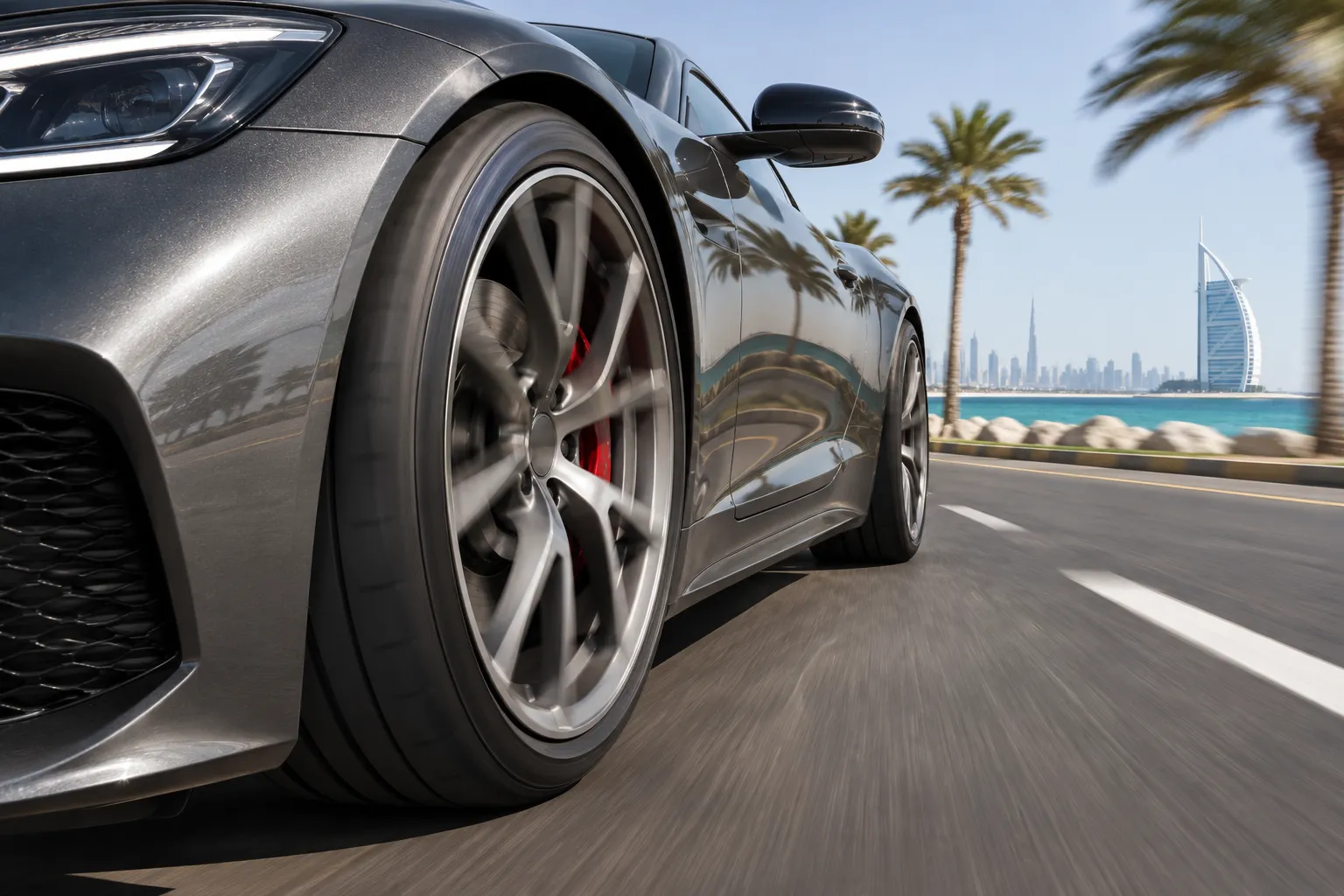
What affects grip, braking, rolling resistance, noise and comfort
Every tyre is a balance. Improving one area usually costs something somewhere else, and tyre makers tune that balance for a category.
| Measure | Main factors | Typical trade-off |
|---|---|---|
| Dry grip and braking | Compound softness, contact patch, block stiffness | Softer compounds wear faster |
| Wet grip and braking | Silica content, sipes, groove volume, tread depth | More sipes can mean squirm in heat |
| Rolling resistance | Compound hysteresis, weight, pressure | Lower resistance can cut wet grip |
| Noise | Tread pitch variation, block size, foam liners | Quieter patterns may drain water less |
| Comfort | Sidewall height and stiffness, construction | Softer sidewalls reduce steering precision |
| Tread life | Compound hardness, tread depth, alignment | Harder compounds grip less |
The EU-style tyre label explained
Tyres made for Europe carry a label that many UAE retailers also show. It grades fuel efficiency (rolling resistance) and wet grip from A to E, and gives external noise in decibels with a class from A to C. Newer labels also show snow and ice symbols where relevant.
In practice, the gap between wet grip A and wet grip C can mean the difference between stopping in time and not. The label is tested in mild conditions, though, so it does not show how a tyre copes with UAE heat. Use it alongside the UTQG temperature grade on US-market tyres and real-world reviews.
- Fuel efficiency: A is lowest rolling resistance, E highest.
- Wet grip: A is shortest wet braking, E longest.
- Noise: shown in dB with a class. Every 3 dB is roughly double the sound energy.
- Snow (3PMSF) and ice symbols: not relevant for UAE driving.
Speed rating and load index tables
The service description after the size, for example 225/45 R17 94W, gives the load index (94) and speed rating (W). Your replacement tyres must match or exceed both values in your owner's manual or door placard. Our article on reading tyre size and the DOT code explains the rest of the sidewall.
| Speed symbol | Max speed | Load index | Max load per tyre |
|---|---|---|---|
| T | 190 km/h | 88 | 560 kg |
| H | 210 km/h | 91 | 615 kg |
| V | 240 km/h | 94 | 670 kg |
| W | 270 km/h | 100 | 800 kg |
| Y | 300 km/h | 106 | 950 kg |
| (Y) | Over 300 km/h | 112 | 1,120 kg |
Tread depth and wet braking
A new car tyre has around 7–9 mm of tread. Dry grip changes little as it wears; some tyres even brake slightly shorter in the dry when worn. Wet braking is a different story. As grooves get shallower, they channel less water, and braking distances on a wet road grow noticeably once the tread drops below about 3 mm.
The minimum in most markets is 1.6 mm, marked by the tread wear indicators in the main grooves. Because UAE rain often arrives as sudden heavy showers on dusty, oily roads, replacing at around 3 mm is a sensible margin if you drive on highways. Our guide on how long tyres last in the UAE covers wear rates by tyre type.
Heat, compound and how tyres age in the UAE
Rubber gets softer as it warms. A compound designed for cold weather can become too soft on 65°C asphalt, giving a greasy feel and fast wear. Summer compounds are designed to reach their best grip at higher temperatures, which is why they suit the UAE.
Heat also ages a tyre. UV and high temperatures break down the oils and antioxidants that keep rubber flexible, so the compound hardens and grip falls even when tread remains. That is why a six-year-old tyre with plenty of tread can still be unsafe. Read more on tyre age and expiry in the UAE.
How to read tyre reviews and tests
Independent tyre tests from European magazines and motoring clubs measure braking distances, handling and wear under controlled conditions. They are useful for ranking tyres, but most are run in temperate weather, so treat heat performance as a separate question.
- Compare tyres tested in the same size and the same test, not across different years.
- Look at wet and dry braking in metres, not just the overall score.
- User reviews on wear and noise are useful in volume, less so one at a time.
- Check whether a reviewer drove in a hot climate before trusting heat comments.
- Be wary of reviews of an older version of the model; names often carry over.
Frequently asked questions
What is the most important tyre performance factor?
Braking, both dry and wet, because it decides whether you stop in time. In the UAE, heat resistance and correct load rating come close behind. Comfort, noise and fuel economy matter, but less for safety.
Does tyre brand affect braking distance?
Yes, but the model matters more than the brand. Independent tests regularly show several metres of difference in wet braking between tyres of the same size. Some mid-range tyres outperform premium ones from a previous generation.
What does the tyre label wet grip grade mean?
It grades wet braking from A (shortest) to E (longest) in a standard test. A tyre graded A stops noticeably shorter in the wet than one graded C or below. It is one of the most useful numbers on the label.
Can I fit a tyre with a lower speed rating?
You should fit at least the rating your car's maker specifies. The rating reflects heat resistance and construction, not just top speed, and fitting a lower one can affect handling and insurance.
At what tread depth should I replace my tyres?
The legal minimum in most markets is 1.6 mm. Wet braking deteriorates well before that, so many technicians recommend replacing at about 3 mm, especially if you drive on highways.
Do cheap tyres perform worse?
Often in wet braking and heat resistance, but not always. Some budget tyres perform reasonably in the dry. Check tests, the wet grip grade and the manufacture date, and avoid unknown brands with no test history.
Related pages
- ServiceNew Tyres
- ServiceTyre Replacement
- ServiceWheel Alignment
- GuideBuy Tyres Online Dubai
- GuideCar Tyre Price in Dubai
- Tyre typePerformance (UHP) Tyres
- Tyre typeSummer Tyres
- Tyre typeEco & Low Rolling Resistance Tyres
- Tyre typeTouring Tyres
- BrandMichelin tyres
- BrandContinental tyres
- BrandBridgestone tyres
- BrandPirelli tyres
- ArticleHow to Read Your Tyre Size and DOT Code
- ArticleTyre Age and Expiry in the UAE
- ArticleBest Tyres for Dubai Summer
- ArticleAre Chinese Tyre Brands Good Enough for UAE Roads?
Stuck with a puncture right now?
Send your location on WhatsApp. A technician confirms the price and heads out, usually within 30–45 minutes in central Dubai.