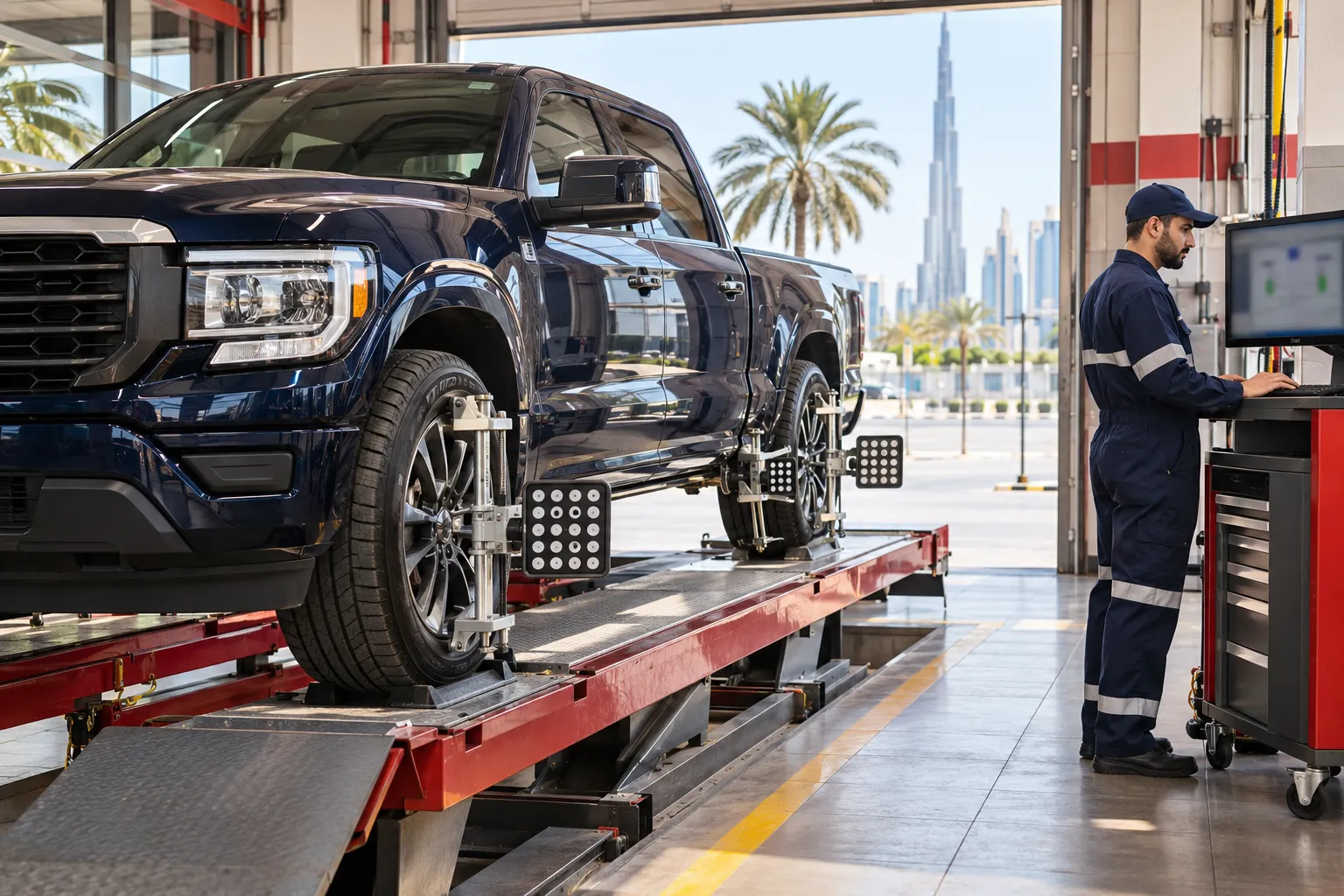
If your car drifts left on a straight stretch of the E11, or the steering wheel sits slightly off-centre when you're going straight, the wheels are no longer pointing where they should. Every kerb in a mall car park and every speed bump taken too fast nudges the geometry a little. Over months it adds up, and the first sign is often a tyre worn down on one edge.
Alignment needs a level rig and a computerised measuring system, so this is the one service we don't do in your car park. We inspect your tyres and steering on site, and the alignment itself is carried out at a partner workshop. If your tyres are already badly worn, we'll suggest replacing them first, since there is little point aligning the car on tyres that will be swapped next week; see new tyres.
What the starting price covers
- Pre-alignment check of tyres, pressures and steering components
- Computerised measurement of all four wheels
- Toe adjustment front and rear where adjustable
- Steering wheel centring
- Before-and-after printout of the angles
What can change the final price
- Large SUVs and 4x4s with heavier suspension
- Camber or caster adjustment that needs extra parts (camber bolts, shims)
- Seized or corroded adjusters and tie-rod ends
- Lowered, lifted or modified suspension
- Steering angle sensor reset after alignment on newer cars
- Collection and return of your car
Signs you need wheel alignment
- The car pulls to one side on a straight, flat road
- The steering wheel is off-centre when driving straight
- Inner or outer edges of the front tyres wearing faster than the middle
- Feathered tread: blocks feel smooth one way and sharp the other
- Tyre squeal on gentle corners at low speed
- You have hit a kerb, pothole or speed bump hard
- Suspension or steering parts have recently been replaced
How we do it, step by step
Time on site: 45–60 minutes on the rig; longer if parts are seized or extra adjustment is needed
- 1
Inspect before adjusting
Tyre pressures are set, and ball joints, tie-rod ends and bushes are checked. Worn parts make alignment pointless, so we tell you first.
- 2
Mount targets and measure
The car is placed on the level rig with turntables. Targets are clamped to each wheel and the system reads toe, camber and caster against the maker specification.
- 3
Adjust the rear, then the front
Rear toe and camber are set first where adjustable, because the rear axle defines the thrust line. Then front toe is adjusted on the tie rods.
- 4
Centre the steering
The steering wheel is locked straight while the final front toe is set, so it sits centred when you drive.
- 5
Road test and printout
A short test drive confirms the car tracks straight. You get a printout showing the before-and-after angles.
Toe, camber and caster in plain English
Toe is whether the front of each wheel points in or out when viewed from above. It has the biggest effect on tyre wear: a couple of millimetres out and the tyre is scrubbed sideways every kilometre. Camber is the inward or outward tilt seen from the front. Too much negative camber wears the inner shoulder, which is common on lowered cars. Caster is the backward tilt of the steering axis, which affects straight-line stability and how the wheel self-centres.
| Angle | What it is | Symptom when wrong | Typical wear |
|---|---|---|---|
| Toe | Wheels pointing in or out from above | Wandering, tyre scrub | Feathering across the tread |
| Camber | Wheel tilt in or out from the front | Pull to one side | One shoulder worn |
| Caster | Tilt of steering axis from the side | Light or heavy steering, pull | Little direct wear |
| Thrust angle | Rear axle direction vs car centre line | Steering off-centre, crab-walk | Uneven wear on all four |
Why UAE driving knocks alignment out
Speed bumps in residential areas, kerbs at mall entrances, steep basement ramps and the occasional pothole on older roads in Deira and Sharjah all load the suspension in ways it is not designed for every day. Desert driving adds more: the impacts of dune bashing at Al Faqa or Big Red will shift alignment on most SUVs. After a desert weekend, or any hard hit, an alignment check is cheap compared with a new pair of front tyres.
Hassan lists the warning signs in 7 signs you need a wheel alignment, and if you've just come back from the dunes, read our desert driving tyre pressure guide before your next trip.
Pull to one side? Rule these out first
Not every pull is alignment. A tyre that is 5 psi lower than its partner will pull, so check pressures first. A tyre with an internal belt shift can also pull, and swapping the front tyres left to right will show it, because the pull changes sides. Sticking brake callipers pull as well and usually make one wheel hot after a drive. Our technician will check these on site before you book the rig.
- Unequal tyre pressures left to right
- A faulty tyre with belt shift (pull moves when tyres are swapped)
- A sticking brake calliper
- Worn control-arm bushes or a bent component after an impact
How often to align, and after what
We suggest an alignment check once a year or every 15,000–20,000 km, and always after new tyres on the front axle, a significant impact, or suspension work. If you rotate tyres regularly with our tyre rotation service, we'll spot early alignment wear when the wheels are off.
Wheel Alignment: questions we get asked
How much is wheel alignment in Dubai?
Wheel alignment starts from AED 99 per car for a standard four-wheel alignment. Large SUVs, modified suspension and seized adjusters cost more.
How do I know if I need a wheel alignment?
The car pulls to one side, the steering wheel is off-centre, or the edges of your tyres are wearing faster than the centre. Any hard kerb or pothole hit is also a reason to check.
How long does a wheel alignment take?
Typically 45–60 minutes. It takes longer if adjusters are seized or extra parts are needed for camber correction.
Should I do alignment after new tyres?
It's a good idea, especially for new front tyres. Misalignment can wear a fresh tyre's edge noticeably within a few thousand kilometres.
Can alignment fix steering wheel vibration?
Usually not. Vibration is normally a balancing problem. Alignment fixes pulling, an off-centre steering wheel and uneven wear.
Is two-wheel or four-wheel alignment better?
Four-wheel alignment is better on almost every modern car, because it sets the rear axle thrust line as well as the front. Two-wheel alignment only adjusts the front.
Can wheel alignment be done at home?
Not accurately. It needs a level rig and calibrated measuring heads, so we inspect on site and carry out the alignment at a partner workshop.
Wheel Alignment near you
Some of the areas we reach every day:
Related pages
- ServiceWheel Balancing
- ServiceTyre Rotation
- ServiceNew Tyres
- ServiceTyre Replacement
- Guide4x4 & SUV Tyres Dubai
- GuideTyre Shop Dubai
- Tyre typeAll-Terrain Tyres
- Tyre typePerformance (UHP) Tyres
- Tyre typeHighway-Terrain Tyres
- Article7 Signs You Need a Wheel Alignment
- ArticleDesert Driving: Tyre Pressure and Tyre Choice
- ArticleHow Long Do Tyres Last in the UAE Heat?
Book wheel alignment now
Send your location on WhatsApp. A technician confirms the price and heads out, usually within 30–45 minutes in central Dubai.