Tyre Care
When Should You Replace Your Tyres? 6 Clear Signs
Short answer
Replace your tyres when the tread reaches about 3 mm (1.6 mm is the legal minimum), when they show sidewall cracks or bulges, or when age and heat have hardened the rubber; in the UAE, have tyres checked every year once they pass five years old. Uneven wear, vibration and repeated punctures are also signs a tyre is near the end.
Key takeaways
- 1.6 mm is the legal minimum tread depth, but plan to replace at around 3 mm because wet braking falls away sharply below that.
- Read the last four digits of the DOT code for the week and year of manufacture, and get tyres checked yearly once they pass five years.
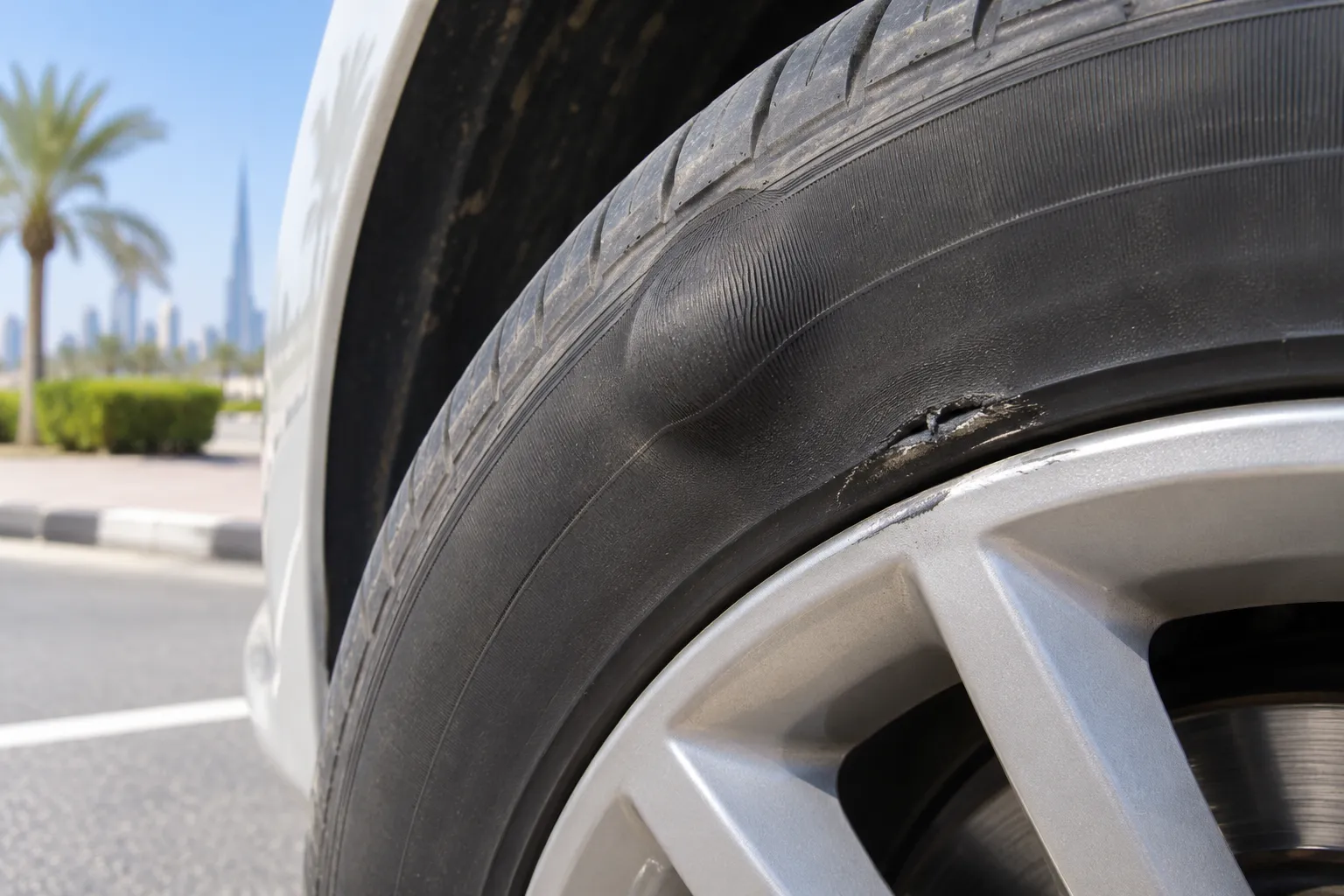
- A bulge on the sidewall means internal damage. Replace that tyre straight away and don't drive at speed on it.
- Fine cracks are a sign of heat and UV ageing; deep cracks that reach the cords mean the tyre is finished.
- Uneven wear and vibration point to alignment, balance or pressure problems that will ruin new tyres too if left.
Replace your tyres when the tread is down to about 3 mm, when the rubber is cracked or bulging, or when the tyre is old enough that heat has hardened it. The legal minimum tread is 1.6 mm, but wet braking falls off well before that. In the UAE, have tyres checked every year once they pass five years from the DOT date. Uneven wear, a vibration that wasn’t there before and repeated punctures are the other signs that a tyre is close to the end.
Most of the tyres I replace aren’t worn out. They’re old, damaged or worn unevenly because something else on the car is wrong. Here are the six signs I look for when I walk round a customer’s car, and what each one means.
1. The tread is getting shallow
Tread depth is the obvious one. The grooves move water out from under the tyre. As they get shallower, the tyre loses grip in the wet and takes longer to stop.
| Tread depth | What it means | What I’d do |
|---|---|---|
| 7–8 mm | New tyre | Nothing |
| 4–6 mm | Healthy | Check monthly, rotate every 10,000 km |
| 3 mm | Getting low | Plan replacement and get quotes |
| 2 mm | Low | Replace soon, avoid long trips in rain |
| 1.6 mm | Legal minimum | Replace now |
How to measure it
Every tyre has tread wear indicators: small raised bars across the bottom of the main grooves. When the tread is flush with them, you’re at 1.6 mm. A tread gauge costs very little at most petrol station shops and gives you a proper reading. Measure the inner edge, the centre and the outer edge, because tyres rarely wear evenly.
I’d rather you replace at 3 mm. That gives you time to compare prices and choose, instead of taking whatever’s in stock after a blowout on Al Khail Road at night.
2. The tyre is old
This is the sign people miss. A tyre can have 6 mm of tread and still be at the end of its life.
Reading the DOT code
On the sidewall you’ll find “DOT” followed by a string of letters and numbers. The last four digits are the manufacture date. 2423 means week 24 of 2023. My guide to reading your tyre size and DOT code shows exactly where to look.
Why heat matters
Rubber ages with heat, oxygen and UV. In Dubai, a car parked outside in July sits on asphalt at 60 to 70°C with the sun on the sidewalls all day. The compound hardens, grip drops and cracks start. I tell customers to have tyres checked every year once they pass five years, and in practice I replace a lot of tyres around that point. Cars that live in covered basements age their tyres more slowly than cars parked on the street in Al Qusais.
Low-mileage cars are the ones that catch people out. I’ve removed tyres from a weekend Mustang in Jumeirah with nearly full tread, seven years old and hard as plastic. More detail in tyre age and expiry in the UAE.
3. Cracks in the sidewall or tread
Look at the sidewall in good light, and at the bottom of the grooves.
- Fine surface crazing, like dry skin, is early ageing. Keep an eye on it and check the DOT date.
- Cracks you can fit a fingernail into mean the rubber has hardened. Plan replacement.
- Cracks that show cords or fabric mean the tyre is finished. Replace it now.
The sidewall is the part that flexes most, and in our climate it’s the part that cracks first. A tyre that has run underinflated cracks faster, which is why I keep coming back to pressure. Our tyre pressure guide covers the right figures and when to check.
4. Bulges and bubbles
A bulge on the sidewall is a broken internal structure. The cords inside have snapped, usually from a pothole, a speed bump taken too fast or a kerb strike in a mall car park, and air is pushing the rubber outward.
A bulge can’t be repaired. The tyre can fail at any time, and it’s most likely to fail at speed and in heat. If you find one, fit the spare or call us, and don’t drive on the motorway in the meantime. I see these most after people clip the high kerbs at petrol station exits and in older basement car parks with tight ramps.
5. Uneven wear or vibration
Uneven wear is a message from the car.
- Both edges worn, centre fine: the tyre has run underinflated.
- Centre worn, edges fine: overinflated. Less common, but I do see it from people who add air when the tyre feels warm.
- One edge worn, usually the inside: alignment is out. Common after speed bumps and kerbs.
- Cupping or scalloped patches: worn shock absorbers or an unbalanced wheel.
- Flat spot: heavy braking that locked the wheel, or a car parked for months without moving.
A vibration through the steering at 100 to 120 km/h usually means a wheel needs balancing. Vibration through the seat points to the rear wheels. If it comes with a pull to one side, read the signs you need a wheel alignment. Sometimes the tyre itself has a separated belt, which is a replacement, not a balancing job.
Whatever the cause, fix it when you fit new tyres. Otherwise the new set goes the same way within months.
6. Repeated punctures or old repairs
One properly done plug-patch repair in the tread area is fine. Several are a different matter.
- A tyre that has had two or three repairs close together is losing its structural strength.
- Punctures within the outer shoulder or sidewall can’t be repaired safely.
- A hole bigger than 6 mm can’t be repaired.
- A tyre that was driven flat for any distance often has hidden damage to the inner liner, even if it holds air afterwards.
- Run-flats have tighter limits. Many makers say not to repair one that has been driven deflated.
If the same tyre keeps losing air, it may be the valve, a cracked rim bead or a tyre that has simply had enough. I’ll tell you which when I take it off.
Replacing in pairs or all four
If only one tyre is damaged and the others are nearly new, replacing one can be fine, as long as it matches the other tyre on that axle in brand, pattern and size. Otherwise replace in pairs on the axle. Put the newer pair on the rear, which keeps the car more stable if grip runs out.
On all-wheel-drive cars, check the handbook. Many want all four tyres within a small difference in tread depth.
A quick monthly check
Five minutes at the petrol station once a month:
- Check cold pressure against the door placard.
- Look at the tread wear indicators on each tyre.
- Run your eye along both sidewalls for cracks and bulges.
- Note the DOT date once, so you know when the five-year mark falls.
- Check the spare as well.
Our tyre care tips go into more of the routine.
Book a replacement
If any of these signs sound familiar, send us a photo of the tyre and the sidewall size on WhatsApp. I’ll tell you honestly whether it needs replacing now or can wait. If it does, we’ll quote options with recent DOT dates and replace it at your home or office through our tyre replacement service, or you can reach us from the contact page.
Frequently asked questions
What is the minimum tread depth in the UAE?
The commonly applied legal minimum is 1.6 mm across the main tread. I recommend replacing at around 3 mm, because stopping distances on wet roads grow quickly as tread gets shallower.
How many years do tyres last in the UAE?
In our heat, many tyres are ready for replacement around five years from manufacture even with tread left, and some sooner if the car is parked in the sun. Have them checked every year once they pass five years, and replace any tyre with deep cracks.
Is a bulge in a tyre dangerous?
Yes. A bulge means the internal cords have broken, usually from a pothole or a kerb, and the tyre can fail without warning. Fit the spare or have the tyre replaced before driving any distance.
How do I check tread depth without a gauge?
Look for the tread wear indicators, the small raised bars in the bottom of the main grooves. When the tread is level with them, the tyre is at about 1.6 mm and must be replaced. A cheap gauge from any ADNOC or ENOC shop gives a more precise reading.
Should I replace all four tyres at once?
Not always. Replace at least in pairs on the same axle so grip is even side to side. On all-wheel-drive cars many makers want all four replaced together, so check the handbook.
Keep reading
Need new tyres? Send us your size
WhatsApp a photo of your tyre sidewall or your car model. We reply with 2–3 options, prices and a fitting slot, often the same day.