Tyre Care
How Often Should You Rotate Your Tyres?
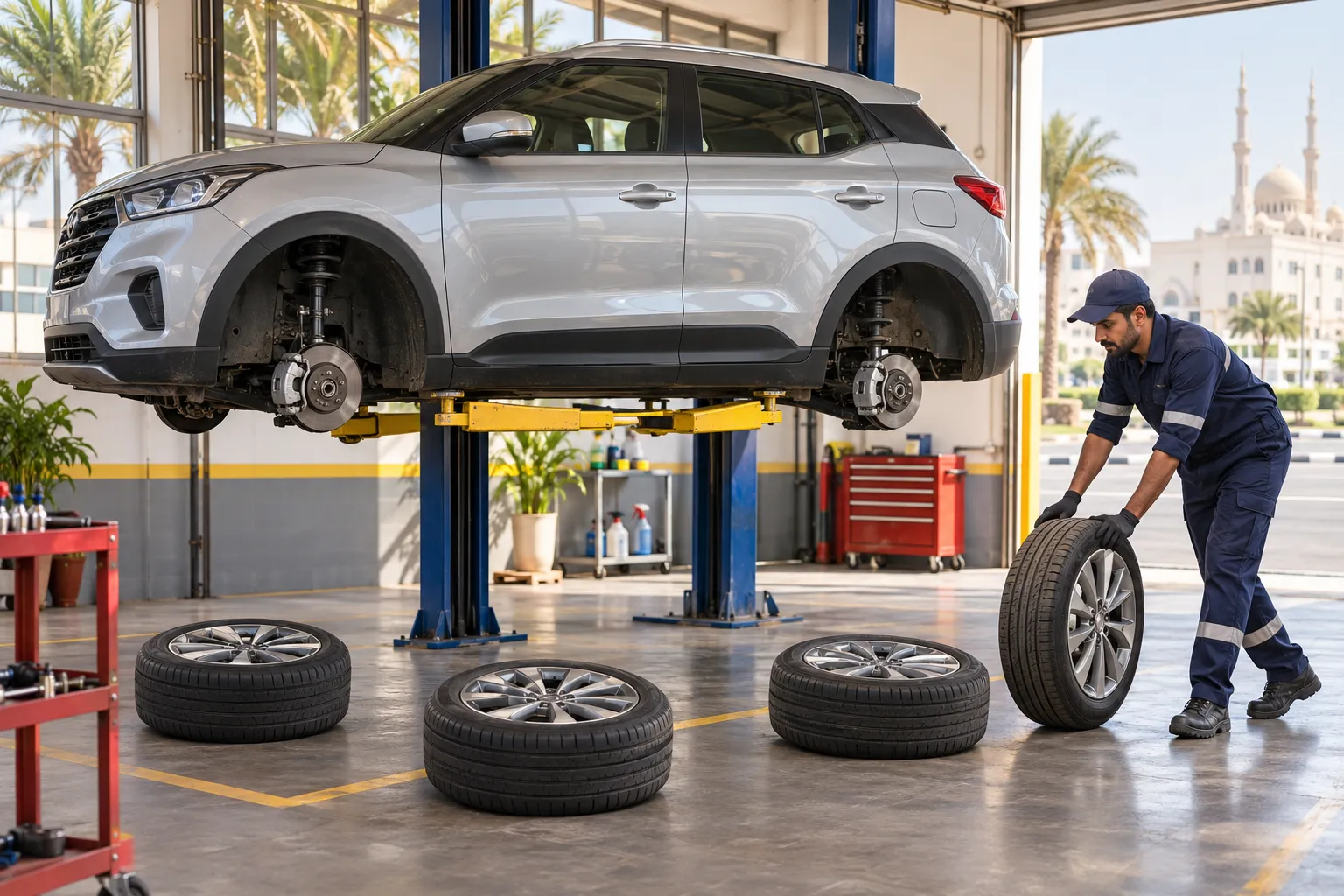
Short answer
Rotate your tyres every 8,000 to 10,000 km, or at every other oil service, which for most UAE drivers works out to about every six months. Front-wheel-drive cars and heavy SUVs benefit most because their front tyres wear much faster.
Key takeaways
- Every 8,000 to 10,000 km suits most cars in the UAE; check your handbook for the manufacturer's figure.
- The pattern depends on drivetrain and whether the tyres are directional or staggered.
- Rotation evens out wear so all four tyres reach the 1.6 mm minimum together, rather than two being replaced early.
- Combine rotation with balancing and a pressure check to get the most from one visit.
- Cars with direct TPMS may need a sensor relearn after the wheels change position.
You should rotate your tyres every 8,000 to 10,000 km. For most people in the UAE that means roughly every six months, or at every other oil service. If your car is front-wheel drive, a heavy SUV, or spends most of its life in stop-start city traffic, aim for the lower end of that range, because the front tyres wear noticeably faster than the rears.
That is the short answer. The longer one depends on your drivetrain, your tyres and how you drive, and that is where most of the mistakes I see on the job come from.
Why tyres wear unevenly in the first place
Each corner of the car does a different job. On a front-wheel-drive Toyota Corolla or Nissan Sunny, the front tyres steer, put down the power and do most of the braking. They can wear twice as fast as the rears. On a rear-wheel-drive car, the rears take the power and the fronts take the steering, so wear is more balanced but different in shape.
UAE roads add their own pattern. Mall car parks and basement ramps mean tight, slow turns, which scrub the front shoulders. Roundabouts in Sharjah and Abu Dhabi do the same. Long straight runs on Sheikh Zayed Road wear the centre of the tread more evenly, but at high temperature.
Rotation moves each tyre to a different position so the wear evens out. The goal is simple: all four tyres reach the end of their life at the same time.
How often: a practical schedule
| Car type | Suggested interval | Why |
|---|---|---|
| Front-wheel-drive saloon or hatchback | 8,000 km | Fronts wear fastest |
| Rear-wheel-drive saloon | 10,000 km | Wear is more balanced |
| AWD or 4x4 SUV | 8,000 to 10,000 km | Even tread depth protects the drivetrain |
| Pickups and vans under load | 8,000 km | Rear tyres carry heavy loads |
| Cars with staggered sizes | Side to side only, if allowed | Fronts and rears are different sizes |
Your owner’s handbook may give a specific figure. Follow it if it does. Some manufacturers specify shorter intervals for AWD models because large differences in tread depth front to rear can stress the centre differential or coupling.
Rotation patterns explained
The right pattern depends on drivetrain and tyre type. These are the ones we use most:
- Forward cross (front-wheel drive). The fronts move straight back. The rears cross over to the opposite side at the front.
- Rearward cross (rear-wheel drive and most 4x4s). The rears move straight forward. The fronts cross over to the opposite side at the rear.
- X-pattern. All four tyres cross diagonally. Often used for AWD cars with non-directional tyres.
- Front to back, same side (directional tyres). Directional tyres must keep rolling the same way, so they only swap front and rear on the same side.
- Side to side (staggered, non-directional). For cars with wider rear tyres, such as many BMWs and Mercedes-Benz models, the only option is swapping left and right on the same axle.
- Five-tyre rotation. If you have a matching full-size spare, it can join the rotation. Many Land Cruiser and Patrol owners do this before desert trips.
Directional tyres have an arrow on the sidewall. Asymmetric tyres have “outside” printed on one sidewall. Asymmetric tyres can cross sides as long as they stay mounted outside-out.
What I check during a rotation
A rotation is the best moment to look closely at every tyre, because each wheel comes off. On a typical job I check:
- Tread depth across the width. Inside, centre and outside. More wear on one edge points to alignment or pressure problems.
- Sidewalls for bulges and cuts. UAE kerbs are high, and sidewall damage hides on the inner face.
- The DOT date code. I’ve found 2017 tyres on cars bought used last year. If you’re not sure how to read it, see my guide on how long tyres last in the UAE.
- Nails and screws. Construction areas like Dubai South and Al Furjan leave a lot of debris. A screw in the tread we can repair on the spot with a plug-patch puncture repair.
- Wheel nuts and studs. Over-tightened nuts from an impact gun are common. We torque to spec by hand.
Rotation, balancing and alignment: how they fit together
These three services are often confused.
Rotation moves tyres to new positions. Balancing corrects uneven weight around the wheel so it spins smoothly. Alignment adjusts the angles of the wheels relative to the car and to each other.
When a tyre moves from the rear to the front, any small imbalance you never felt at the back can show up as steering vibration at 100 to 120 km/h. That is why I often recommend adding wheel balancing to a rotation, especially if the tyres are more than a year old.
If the tread shows feathering or one edge worn much more than the other, the car probably needs alignment. Rotating without fixing it just spreads the bad wear to all four tyres. My list of signs you need a wheel alignment will help you spot it.
TPMS after rotation
Cars with direct TPMS have a sensor in each wheel. Some cars learn the new positions automatically after a short drive. Others, including several Toyota, Lexus and Hyundai models, need a relearn with a tool, or the dashboard will report the wrong corner when one tyre is low. We carry the tool for common makes, and if a sensor turns out to be dead, we handle it through our TPMS sensor service.
What happens if you skip it
A customer in Mirdif last year had a Nissan X-Trail with fronts down at 2 mm and rears still at 6 mm, all bought on the same day 40,000 km earlier. He needed two new fronts immediately. If he had rotated every 8,000 km, all four would have been around 4 mm and he would have had another year from them. Not rotating doesn’t make a car unsafe straight away, but it makes you buy tyres sooner and drive with different grip front and rear.
What rotation costs with us
Our tyre rotation service starts from AED 59 per car, done at your home or office. The final price depends on:
- Wheel size and whether the car has locking wheel nuts
- Whether you add balancing or a five-tyre rotation
- Whether TPMS sensors need relearning
- Your location and the time of the callout
Can you rotate tyres yourself?
You can, if you have a proper trolley jack, axle stands and a torque wrench. The scissor jack in your boot is for emergencies only, and it isn’t safe for lifting one corner after another. Most of the problems I see after home rotations come from two things: wheel nuts tightened in the wrong order or to the wrong torque, and directional tyres fitted the wrong way round. A warped brake disc or a loose wheel costs far more than the rotation. If you do it yourself, tighten the nuts in a star pattern, torque them to the figure in the handbook, and check them again after 50 km.
There’s also the heat. Working on a driveway in July at 45°C is hard on you, and the wheel nuts and hub can be too hot to touch after a drive. Do it in the early morning, after the car has stood overnight.
When to call us
If your last rotation was more than 10,000 km ago, or you can’t remember it, book one. Tell us the car model and whether the tyres are the same size front and rear, so the technician plans the right pattern. You can contact us any time and we’ll come to you, in a villa driveway in Arabian Ranches or a basement in Downtown.
Frequently asked questions
How often should tyres be rotated in Dubai?
Every 8,000 to 10,000 km is a good rule for most cars. If you drive mostly in city traffic with lots of turning, or you have a front-wheel-drive car, stay closer to 8,000 km.
How much does tyre rotation cost in Dubai?
Our tyre rotation starts from AED 59 per car. The price moves with wheel size, whether balancing is added, and whether TPMS sensors need relearning afterwards.
Is it bad to never rotate your tyres?
It isn't dangerous on its own, but it costs you money. The front or rear pair wears out well before the other, so you buy tyres in pairs more often and may end up with mismatched grip front to rear.
Can you rotate tyres with different sizes front and rear?
Not front to rear. Staggered setups can only be swapped side to side, and only if the tyres are not directional. With directional staggered tyres, rotation isn't possible without remounting.
Should I rotate tyres or do an alignment first?
Rotate first, then align if needed. If uneven wear suggests an alignment problem, fix the alignment at the same visit, otherwise the rotated tyres will start wearing unevenly again.
Keep reading
Stuck with a puncture right now?
Send your location on WhatsApp. A technician confirms the price and heads out, usually within 30–45 minutes in central Dubai.