Safety
Space-Saver vs Full-Size Spare Tyre
Short answer
A full-size spare is better for UAE drivers because it can run at normal speed, suits long highway and desert trips, and can join your tyre rotation. A space-saver is lighter and saves boot space, but most are limited to 80 km/h and are meant only to get you to a tyre shop.
Key takeaways
- Most space-savers are limited to 80 km/h, printed on a sticker on the wheel or in the handbook.
- A space-saver gets you to a tyre shop; it is not for a 150 km run to Abu Dhabi.
- Full-size spares are best for SUVs, desert trips and long highway driving.
- Spares age in the boot heat even if never used; check the DOT date.
- Check the spare's pressure every month or two; space-savers usually need about 60 psi.
A full-size spare is the better choice for most UAE drivers. It lets you carry on at normal speed, it copes with long highway runs and desert trips, and if it matches your other tyres it can join the rotation. A space-saver is lighter and frees up boot space, but it is a temporary tyre: most are limited to 80 km/h and are meant only to get you to the nearest tyre shop. If your car came with a space-saver, that’s fine for city driving, as long as you know its limits.
I’m Hassan Faaz. In eight years of roadside callouts across Dubai, Sharjah and Abu Dhabi, the spare tyre is one of the most neglected parts of any car I see. Here is how the two types compare and what I’d recommend.
What each type actually is
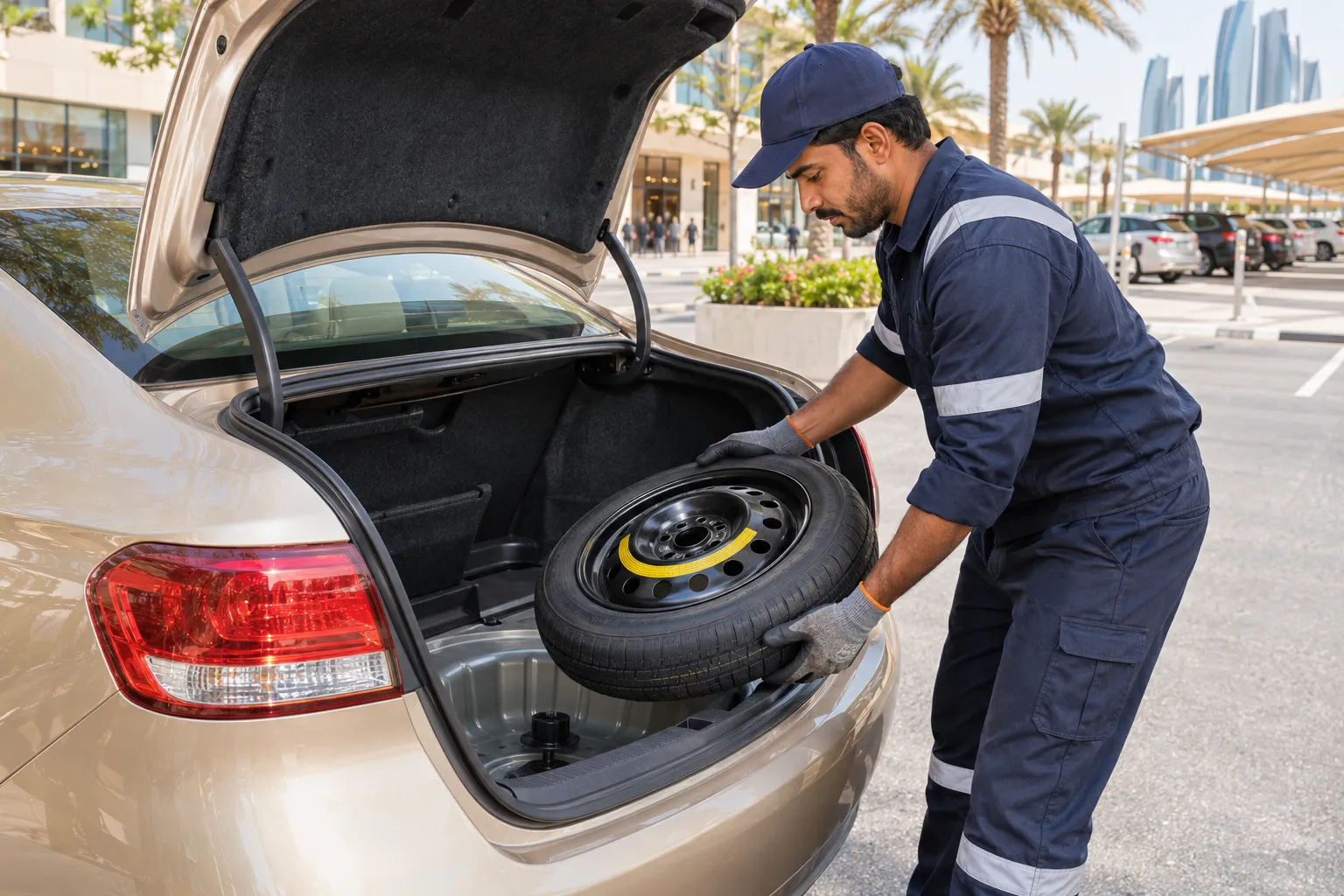
A space-saver (also called a temporary spare, “T-type” or “donut”) is a narrow tyre on a lightweight steel wheel. It’s usually marked with a size starting with T, such as T125/70 R17, and a yellow or orange sticker with the speed limit. It runs at high pressure, often 60 psi, to carry the car’s weight on a small tyre.
A full-size spare is the same size as your road tyres. It may be on a matching alloy wheel or a cheaper steel wheel. Most body-on-frame SUVs in the UAE, such as the Land Cruiser, Patrol and Prado, carry one under the car or on the tailgate.
Some newer cars have neither. They come with run-flat tyres or a sealant and compressor kit. I cover those in my post on whether tyre sealant kits work.
Side-by-side comparison
| Space-saver | Full-size spare | |
|---|---|---|
| Speed limit | Usually 80 km/h | Normal tyre speed rating |
| Distance | Short, to reach a shop | Unlimited if it matches |
| Weight | Light | Heavy, 20–30 kg+ on SUVs |
| Boot space | Saves space | Takes space unless under-mounted |
| Grip and braking | Reduced, narrow footprint | Same as road tyres |
| Pressure | Often around 60 psi | Normal placard pressure |
| AWD compatibility | Limited, short use only | Fine if size and tread match |
| Can join rotation | No | Yes, if identical |
Driving on a space-saver: the rules
If you’ve just fitted a space-saver after a puncture on Al Khail Road, these are the things to remember:
- Stick to the speed limit on the sticker. Usually 80 km/h. On UAE highways, that means staying in the right-hand lane with hazard lights if traffic is fast.
- Keep the distance short. Go to a tyre shop or call a mobile service. Don’t do the school run on it for a week.
- Expect longer braking distances. The narrow tyre has less grip, especially in an emergency stop.
- Avoid heavy loads. Don’t tow or fully load the car.
- Check its pressure. A space-saver that’s been sitting at 30 psi for three years is not ready to do its job.
- Watch the dashboard. Traction control and ABS may react to the different wheel speed. That’s normal for a short time.
On AWD cars, a much smaller tyre turns faster than the others, and the drivetrain has to make up the difference. Some manufacturers allow it for short distances; others advise against it on the rear axle. The handbook is the authority here.
Why full-size makes more sense in the UAE
Distances here can be long and empty. If you get a puncture on the E11 between Dubai and Abu Dhabi, or on the road to Liwa, a space-saver at 80 km/h is a long, slow drive with heavy trucks passing at 120 km/h. A full-size spare lets you drive normally to your destination.
For desert driving, a space-saver is useless. It can’t be aired down and has no sand performance. Any 4x4 that goes into the dunes should carry a full-size spare in good condition. I explain why in my desert driving tyre pressure guide.
The problem nobody checks: spare tyre age
A spare tyre lives in the hottest part of the car. In July, a boot or under-floor spare well can get far hotter than the cabin. Rubber ages with heat and time whether the tyre rolls or not.
I regularly find spares that have never touched the road and are already cracked. Last month a customer in Al Nahda, Sharjah, had a 2015 full-size spare on her Pajero. It looked new, with fresh tread, but there were fine cracks between the tread blocks and around the bead. We didn’t fit it. Instead we repaired her punctured tyre and recommended a replacement spare.
How to check yours:
- Find the DOT code. The last four digits are the week and year of manufacture, for example 2219 means week 22 of 2019. Our post on tyre age and expiry in the UAE explains what to look for.
- Look for cracks in the sidewall and between tread blocks.
- Check the pressure every month or two.
- Check that the jack and wheel brace are there. Used cars often come without them.
What about mismatched full-size spares?
A full-size spare is only “full-size” if it matches. A spare from a different brand with a different tread pattern is fine for getting home, but on AWD cars it should have very similar tread depth to the other tyres. A new full-depth spare next to three tyres at 3 mm can create a diameter difference large enough to matter.
If you have a matching full-size spare, include it in a five-tyre rotation. That spreads wear over five tyres and keeps the spare from ageing unused.
Which should you choose?
- City car, mostly Dubai traffic: a space-saver is acceptable if it’s in good condition and you know its limits.
- Frequent highway trips between emirates: a full-size spare is worth the space.
- SUV or 4x4 used off-road: a full-size spare is essential.
- Car with run-flats: no spare is normal, but know the run-flat distance limit.
- Sealant kit only: consider buying a space-saver if it fits your boot well, as sealant can’t fix larger damage.
Changing to the spare safely
Most of our spare tyre callouts aren’t because people can’t change a wheel. They’re because the roadside isn’t safe, the wheel nuts are seized, or the locking wheel nut key is missing. If you do it yourself:
- Get well off the road. A petrol station or quiet side street is far better than the shoulder of the E311.
- Use the jacking points marked in the handbook. Jacking on the wrong spot can damage the sill or slip.
- Loosen the nuts before lifting, while the tyre is still on the ground.
- Never put any part of your body under the car on a scissor jack.
- Tighten in a star pattern and check the torque at the next stop.
- Check the spare’s pressure before you set off, using a gauge from your boot or the next ADNOC or ENOC station.
If any of this isn’t possible where you are, stay safe and wait for help.
When to call us
If you’ve had a flat and don’t want to change it yourself on a busy road, we can fit your spare for you through our spare tyre fitting service, from AED 79 per callout. If the spare itself is flat or too old, we can bring a new tyre and fit it on the spot, or repair the punctured tyre so you’re back on four proper wheels. Our roadside flat tyre help in Dubai covers what happens on a callout. If you’re stuck on the shoulder, move behind the barrier first, then contact us.
Frequently asked questions
How fast can you drive on a space-saver spare?
Most space-savers are limited to 80 km/h. Check the sticker on the wheel or the owner's handbook for your car's exact limit, and drive gently, avoiding hard braking.
How far can you drive on a space-saver tyre?
They are designed for short distances, usually enough to reach a tyre shop. Many manufacturers suggest keeping it under roughly 80 to 100 km in total, but the handbook gives the figure for your car.
Can I use a space-saver on an AWD car?
Only for a short distance and as the manufacturer allows. The smaller diameter can strain the centre differential or coupling on some AWD systems, so follow the handbook and replace it with a proper tyre quickly.
Do spare tyres expire?
Yes. Rubber ages even if the tyre is never used, and the heat in a UAE boot speeds this up. A spare much older than about six years should be inspected closely, and replaced if there are cracks or it is near ten years old.
Can I buy a full-size spare for a car that came with a space-saver?
Often yes, if a matching wheel fits the spare well or you're happy to carry it in the boot. Check that the size matches your other tyres and that it doesn't affect the boot floor or any sensors.
Keep reading
Stuck with a puncture right now?
Send your location on WhatsApp. A technician confirms the price and heads out, usually within 30–45 minutes in central Dubai.