Off-Road
Desert Driving: Tyre Pressure and Tyre Choice
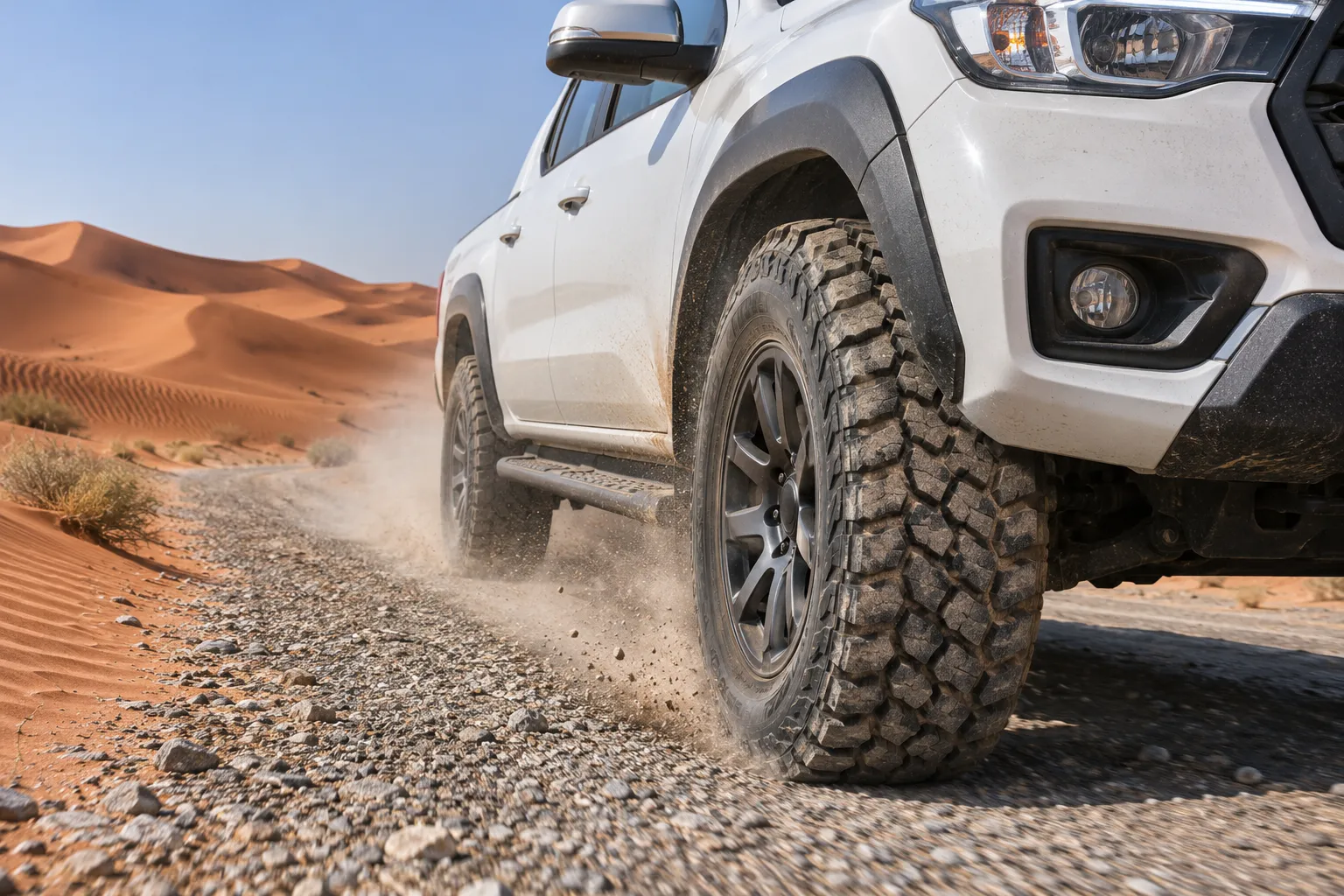
Short answer
For UAE dune driving, most 4x4s run 15 to 18 psi in soft sand, dropping to around 12 to 14 psi only in very soft dunes like Liwa, and must be reinflated to road pressure before returning to tarmac. All-terrain tyres are the best all-round choice for drivers who do both highway and desert.
Key takeaways
- Air down to 15 to 18 psi for most UAE dunes; go lower only in very soft sand and only at low speed.
- Keep speed under about 40 km/h when aired down, and avoid sharp turns that can roll a tyre off its bead.
- Reinflate to the door-placard pressure before driving on tarmac, every time.
- All-terrain tyres suit most UAE owners; mud-terrains are rarely needed for sand.
- Carry a gauge, a deflator, a 12V compressor, a recovery kit and a full-size spare.
For desert driving in the UAE, drop your tyre pressure to around 15 to 18 psi before you hit the sand. That is enough for most dunes around Al Qudra, Big Red near Al Madam and the Sharjah desert. In very soft sand, like the big dunes around Liwa, experienced drivers go as low as 12 to 14 psi. Whatever you run in the sand, put the pressure back up to the figure on your door placard before you drive on tarmac again.
I’m Hassan Faaz, a tyre technician in the UAE for eight years. Every winter season I get calls from the desert edge: tyres off the bead, sidewalls cut on rocks, or drivers who came back to the highway at 15 psi and cooked a tyre. Most of it is avoidable.
Why you air down in sand
A tyre at road pressure, around 32 to 36 psi on most SUVs, has a small, stiff contact patch. In soft sand it digs in instead of floating. Lowering the pressure lets the tyre flatten and lengthen its footprint. A longer, wider patch spreads the weight of the car over more sand, so it rides on top.
You don’t need to be extreme. Each step down makes a difference, and going too low brings its own problems.
Pressure by terrain
| Terrain | Typical pressure | Notes |
|---|---|---|
| Tarmac, highway | Door placard (often 32–36 psi) | Never drive at speed below this |
| Graded gravel tracks (Hatta wadis, Jebel Jais approach roads) | 25–28 psi | Reduces stone cuts and improves ride |
| Firm sand, beginner dunes | 18–20 psi | Good starting point |
| Normal UAE dunes (Al Qudra, Big Red, Fossil Rock) | 15–18 psi | Where most people run |
| Very soft sand (Liwa, Moreeb area) | 12–14 psi | Low speed, smooth inputs only |
| Stuck, recovery | 10 psi briefly | Only to get out, then reinflate |
These figures are for typical 4x4s like the Toyota Land Cruiser, Nissan Patrol, Jeep Wrangler and Prado on light-truck or SUV tyres. A heavily loaded car with roof tent and fuel cans may need a couple of psi more to protect the sidewalls. Always measure with a gauge. Counting seconds with the valve open is guesswork.
How to air down properly
- Stop at the edge of the sand on firm ground. Not on the highway shoulder.
- Check all tyres cold if you can. After an hour on the E66 or E11 they will read high, so let them sit a few minutes or allow for it.
- Use a deflator with a gauge. Screw-on automatic deflators are good for consistency.
- Let all four down to the same pressure. Different pressures side to side make the car pull on slopes.
- Check again after the first 20 minutes. Sand heats tyres fast in the afternoon and pressures rise.
Driving on low pressure
Low pressure changes how the tyre behaves. Respect it.
- Keep speed down. About 40 km/h is a sensible limit when aired down. Higher speeds overheat the sidewall.
- No sharp turns on slopes. A hard turn on a dune face is the classic way to roll a tyre off its bead. Steer smoothly and keep momentum.
- Avoid hard braking downhill. Ease off and let the car crawl.
- Watch for rocks. At low pressure the sidewall bulges and is more exposed. Sharp stones near Fossil Rock and Mleiha cut sidewalls easily.
Last winter a group near Big Red called us for a Patrol whose front-left tyre had lost its bead at around 10 psi on a steep side slope. The tyre was fine, the rim was fine, but it took a jack, a ratchet strap and a compressor to reseat it. Running 14 psi instead of 10 would probably have avoided it.
Airing back up before the road
This is the step people skip, and it is the dangerous one. A tyre at 15 psi on Emirates Road at 120 km/h flexes far beyond what it was designed for. The sidewall heats up, the rubber and cords separate, and the tyre can fail without warning. I’ve replaced several tyres that looked fine on the outside but had a ring of melted rubber inside the sidewall.
Options:
- A good 12V compressor. Get one rated for continuous duty, connected directly to the battery, not a cigarette-lighter type. Expect a few minutes per tyre.
- Drive slowly to a petrol station. If you have no compressor, keep it under 40 km/h with hazards on and use the nearest ADNOC, ENOC or Emarat air machine.
- Call us. If you’re stuck at the desert edge outside Dubai or Sharjah with a damaged tyre, we can often reach you, depending on access.
Reinflate to the door placard figure. My guide on the correct tyre pressure for UAE summer explains how to set it when the tyres are hot.
Choosing tyres for desert and road
Most UAE 4x4 owners drive 90% on tarmac and 10% in sand. Choose for that.
All-terrain (AT)
All-terrain tyres are the best fit for most people. They air down well, have tougher sidewalls than highway tyres, and are still reasonably quiet on the road. Look for light-truck (LT) construction if you carry heavy loads or go rock hopping in Hatta. The BFGoodrich KO2 is the one I see most at the dunes, and you can find it on our BFGoodrich page.
Highway-terrain (HT)
Most factory Land Cruisers and Patrols come on highway-terrain tyres. They work in sand if you air down and drive carefully, but the sidewalls are thinner and the tread fills with sand quickly. Fine for occasional, gentle trips.
Mud-terrain (MT)
Mud-terrain tyres look the part, but in sand their big lugs tend to dig rather than float. They’re noisy on the highway and wear faster on hot tarmac. Worth it only if you do serious rock and wadi work, not for dunes.
For a detailed comparison by car and budget, see my post on how to choose SUV tyres, or our page on 4x4 tyres in Dubai.
Kit checklist for a desert trip
- Accurate tyre pressure gauge
- Deflators
- 12V compressor rated for large tyres
- Full-size spare at correct pressure, checked for age
- Tyre plug kit for tread punctures
- Recovery boards, shovel, kinetic rope and rated shackles
- Base plate for the jack, because a jack sinks in sand
- Plenty of water
A full-size spare matters out there. A space saver is no use in the sand.
Common mistakes I see after desert trips
- Unequal pressures. One tyre at 20 psi and the rest at 15 makes the car pull and dig on one side.
- Forgetting the spare. It sits for months and is often at 20 psi when it’s needed.
- Driving home on low pressure. Even 30 km at 80 km/h on 16 psi can damage a sidewall from the inside.
- Ignoring small cuts. A cut in the sidewall from a desert rock can’t be repaired and gets worse with heat.
- Old tyres. Rubber that has cracked from years in the sun doesn’t flex well at low pressure. Check the DOT code before the season.
If you notice a slow leak a few days after a trip, look for sand-packed thorns or small stones in the tread. These often work their way in slowly.
When to call us
Get your tyres checked before the season starts. We look at tread depth, sidewall cuts, DOT dates and the spare, and repair any tread punctures on the spot. If you come back from the desert with a slow leak or a cut, don’t keep reinflating it. Call us and we’ll come to your home in Dubai, Sharjah or Abu Dhabi to repair or replace it.
Frequently asked questions
What tyre pressure should I use for dune bashing?
Start at 15 to 18 psi for most dunes around Dubai and Sharjah. In very soft sand, like parts of Liwa, experienced drivers go to 12 to 14 psi, but only with careful, low-speed driving and the right tyres.
Can I drive on the highway with low tyre pressure after the desert?
No. Driving at highway speed on 15 psi overheats the sidewalls and can destroy the tyre or cause a blowout. Reinflate at the desert edge or drive slowly to the nearest petrol station.
Are all-terrain tyres good for UAE desert driving?
Yes. They are the most popular choice because they handle sand well when aired down and still behave on the highway. Mud-terrains are louder on the road and offer little extra on sand.
Can a tyre come off the rim in the desert?
Yes, if pressure is very low and you turn sharply or brake hard on a slope. The bead unseats and the tyre deflates. Smooth steering and staying above about 12 psi reduce the risk.
Should I use nitrogen for desert trips?
There is little point, because you will release most of it when airing down and refill with air from a compressor. Nitrogen makes more sense for daily highway driving.
Keep reading
Stuck with a puncture right now?
Send your location on WhatsApp. A technician confirms the price and heads out, usually within 30–45 minutes in central Dubai.