Tyre Pressure
Correct Tyre Pressure for UAE Summer
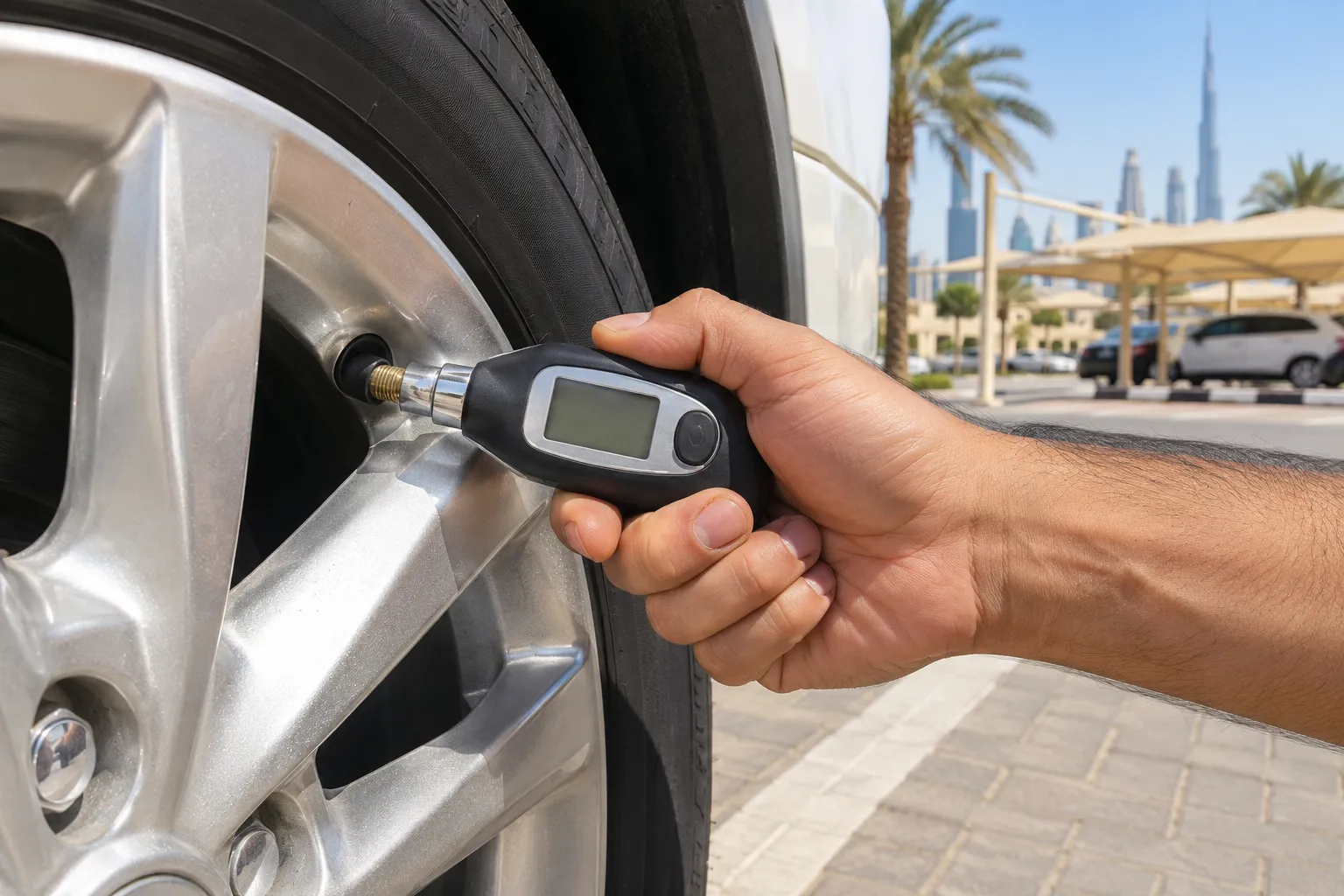
Short answer
The correct tyre pressure for UAE summer is the cold pressure on your car's door placard, usually 32 to 36 psi for saloons and 33 to 38 psi for SUVs. Check it early in the morning before driving, and never let air out of hot tyres because the reading has risen in the heat.
Key takeaways
- Use the cold pressure on the door placard or fuel flap, not the maximum printed on the tyre sidewall.
- Check pressures first thing in the morning, before the car has been driven or parked in the sun.
- A tyre's pressure can rise 3 to 5 psi after a summer drive; that is normal and you should not bleed it off.
- Underinflation is far more dangerous than slight overinflation in UAE heat, because a soft tyre flexes and overheats.
- Use the higher placard figure when the car is fully loaded for a long trip to Hatta, Liwa or Oman.
The correct tyre pressure for UAE summer is the cold pressure printed on your car’s placard, usually inside the driver’s door frame or the fuel flap. For most saloons and hatchbacks that’s 32 to 36 psi. For SUVs and pickups it’s usually 33 to 38 psi, with a higher figure for heavy loads. Check it early in the morning before you drive. When the tyre warms up in the afternoon the reading will rise by a few psi, and that’s normal. Don’t let air out to “correct” it.
I see the same mistakes every summer, and most of them come from one misunderstanding: that heat means you should run softer tyres. It’s the other way round.
Where to find your car’s correct pressure
The car maker sets the pressure, not the tyre maker. Look in these places:
- Door placard. A sticker on the B-pillar when you open the driver’s door. It’s the most common location.
- Fuel filler flap. Common on European cars.
- Owner’s handbook. Usually in the wheels and tyres section.
- Glovebox lid. On some older Japanese models.
The placard often shows two sets of figures: one for normal load and one for full load (all seats and luggage). Some also show a different figure for front and rear.
Do not use the number moulded into the tyre sidewall, something like “MAX PRESS 51 PSI”. That’s the maximum the tyre can safely hold, not what your car needs.
Typical cold pressures by vehicle type
These are typical ranges I see on UAE cars. Your placard is the final word.
| Vehicle type | Example | Typical cold pressure (psi) |
|---|---|---|
| Small saloon / hatchback | Nissan Sunny, Toyota Yaris | 32–35 |
| Mid-size saloon | Toyota Camry, Honda Accord | 33–36 |
| Compact SUV | Nissan X-Trail, Toyota RAV4 | 33–36 |
| Large SUV | Toyota Land Cruiser, Nissan Patrol | 32–38 (higher when loaded) |
| Performance saloon | BMW 5 Series, Mercedes E-Class | 33–42 (often differs front and rear) |
| Pickup / van | Toyota Hilux, Hiace | 35–50+ on the rear when loaded |
If you drive a Land Cruiser or Prado, our Toyota tyres page lists the common sizes and what they’re rated for.
Why “cold” matters so much in the UAE
Air expands when it heats. A widely used rule of thumb is about 1 psi for every 5 to 6°C change in tyre temperature. Here, the swings are big:
- A car parked overnight in a cool basement at 28°C.
- The same car after 20 minutes on the E311 at noon, with the asphalt at 65°C.
- The tyre’s internal temperature can climb well above the air temperature.
A tyre set to 34 psi in the basement can easily read 37 to 39 psi after that drive. That increase is built into the placard figure. The car maker expects it.
The trouble starts when someone checks pressure at an ENOC or ADNOC station at 2 pm after driving, sees 38 psi, and lets air out back down to 34. When that tyre cools overnight, it’s sitting at maybe 30 or 31 psi cold. Underinflated. Next afternoon on the motorway, it flexes more, heats more, and the cycle continues.
Rule: check cold, or if you must check hot, only add air if it reads below the placard figure. Never remove air from a hot tyre.
Underinflation is the real summer danger
Nearly every summer blowout I attend has the same story behind it. The tyre was low. When a tyre is underinflated:
- The sidewall flexes more with every rotation.
- Flexing creates heat inside the rubber and the cords.
- On asphalt at 60–70°C, there’s nowhere for that heat to go.
- The rubber weakens, the plies start to separate, and the tyre fails, often with a bang.
Last August I attended a Nissan Patrol on the Hatta road. Rear left tyre, completely shredded. The owner had been topping it up once a week for a month because “it was always a bit low”. There was a small screw in the tread. A slow leak combined with a fully loaded car and 46°C heat. The repair would have taken fifteen minutes weeks earlier. I’ve written more about this in why tyres burst in UAE summer.
Is slight overinflation a problem?
A couple of psi over the placard figure won’t hurt in summer. The ride is a little firmer, and the centre of the tread may wear slightly faster over many months. What you shouldn’t do is pump tyres to the sidewall maximum. Grip drops because the contact patch shrinks, and braking distances get longer, especially on dusty roads.
Adjusting for load and long trips
Summer is when families drive to Oman, Hatta, Fujairah or Liwa with the boot full. Use the full-load figure from the placard for these trips. On a Land Cruiser, the difference can be 3 to 6 psi on the rear. Set it the morning you leave, cold.
Going off-road into the sand is a different story. Dropping pressure for the dunes is correct, but it must go back up before you rejoin the tarmac. Our desert driving tyre pressure guide covers that in detail.
Does nitrogen help in summer?
Nitrogen molecules pass through rubber a little more slowly than oxygen, so a nitrogen-filled tyre loses pressure more gradually. Dry nitrogen also has no moisture, which means pressure changes with temperature are slightly more predictable. It doesn’t stop heat expansion, and it doesn’t replace regular checks. For AED 10 per tyre, many of my customers find it worthwhile. Our nitrogen inflation service and the nitrogen tyre filling in Dubai page explain the pros and cons honestly.
Using your TPMS properly
Most cars from the last decade have a tyre pressure monitoring system. Direct TPMS uses sensors in each wheel and shows live pressures on the dash. Use it, but understand what it tells you:
- The reading will rise through the day. That’s normal.
- A warning light means pressure has dropped well below target, often 20–25% low. That’s already too low in this heat.
- One tyre consistently reading 2 or 3 psi lower than the others means a slow leak. Get it checked.
- A flashing TPMS light usually means a sensor fault, not low pressure. Sensor batteries typically last several years and die without warning.
If a sensor has failed or the light won’t clear, our TPMS sensor service can test, replace and program sensors at your location.
A simple summer routine
- Buy a decent digital gauge and keep it in the glovebox. Petrol station gauges vary.
- Check all four tyres and the spare once every two weeks, before your morning drive.
- Set them to the placard figure. Use the full-load figure for long trips.
- Look at the tread and sidewalls while you’re down there. Cracks, bulges, or screws are all reasons to call.
- If one tyre keeps losing air, don’t keep topping it up. Get the cause found.
For more on what pressure does to wear, grip and fuel use, see our main tyre pressure guide.
When to call us
If a tyre keeps dropping, your TPMS light won’t go out, or you’d like all four tyres checked and set before a summer road trip, book a visit through our contact page. A technician can come to your home or office, find any slow leaks, and set the pressures cold before your car has moved.
Frequently asked questions
What is the correct tyre pressure in summer in Dubai?
Use the cold pressure shown on the placard inside your driver's door or fuel flap. For most saloons that is 32 to 36 psi, and for SUVs 33 to 38 psi, checked before driving.
Should I lower my tyre pressure in summer?
No. Lowering the cold pressure below the placard figure makes the tyre flex more and run hotter, which raises the risk of a blowout. Set the placard pressure cold and leave the hot rise alone.
Why does my TPMS show higher pressure in the afternoon?
Air expands as it heats, so a tyre that read 34 psi in the morning can show 37 or 38 psi after driving on hot asphalt. This is expected and the tyre is designed for it.
How often should I check tyre pressure in the UAE?
At least once a month and before every long trip. In summer, every two weeks is better, because slow leaks and heat cycling show up faster.
Is the pressure on the tyre sidewall the right one to use?
No. The sidewall shows the maximum pressure the tyre can hold, not what your car needs. Always use the vehicle maker's placard figure.
Keep reading
Stuck with a puncture right now?
Send your location on WhatsApp. A technician confirms the price and heads out, usually within 30–45 minutes in central Dubai.