Safety
Why Tyres Burst in UAE Summer (and How to Prevent It)
Short answer
Tyres burst in UAE summer mainly because under-inflation, overloading, old rubber or hidden impact damage make the tyre overheat on asphalt that can reach 60 to 70°C. Keeping pressures correct, replacing aged tyres and checking for bulges prevents most blowouts.
Key takeaways
- Heat alone rarely bursts a healthy tyre; heat plus a weakness does.
- Under-inflation is the biggest cause: a soft tyre flexes more and builds heat fast.
- Old tyres, even with plenty of tread, are a real risk; check the DOT date.
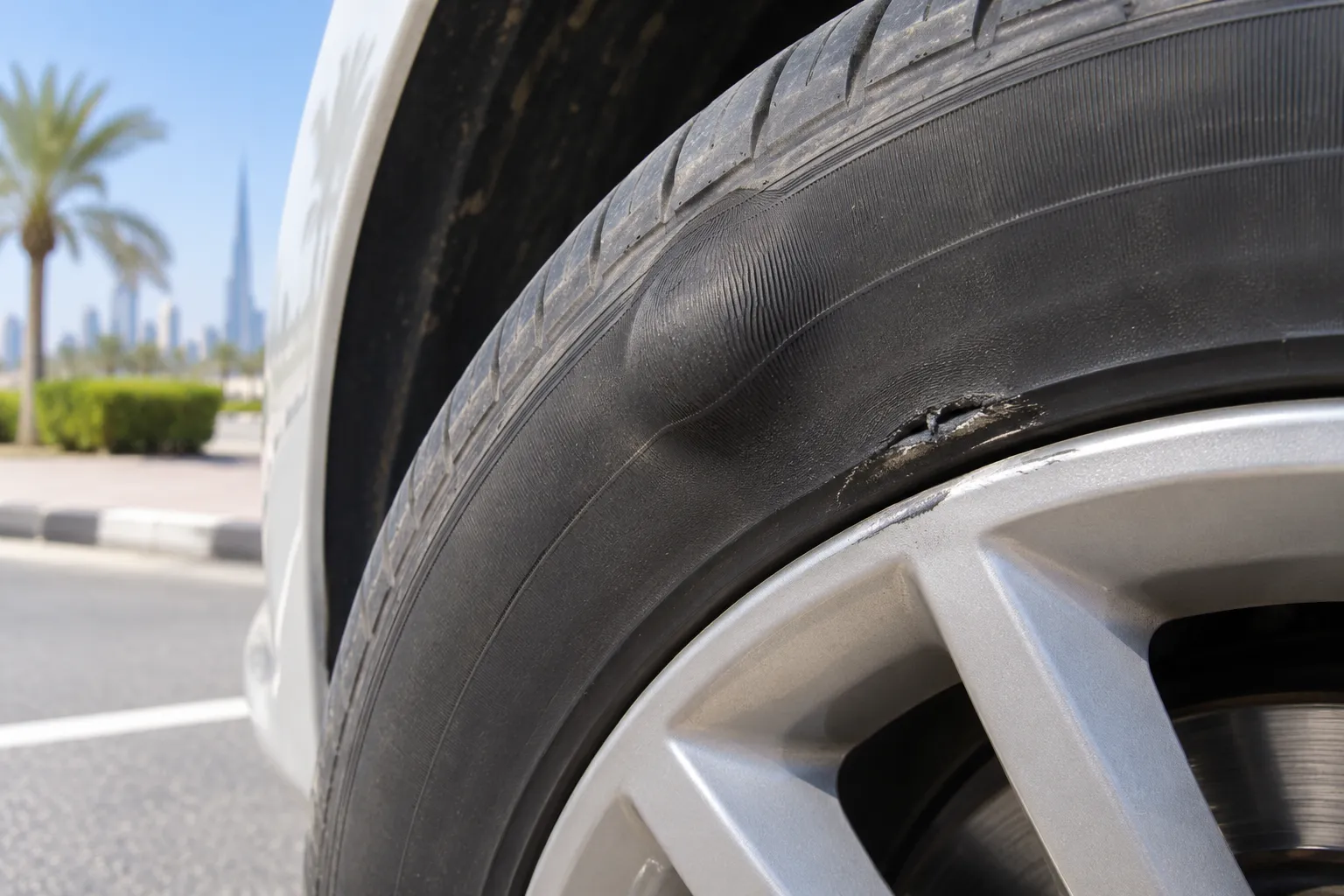
- Sidewall bulges mean the tyre structure is broken and it must be replaced.
- If a tyre bursts, hold the steering firmly, don't brake hard, and slow down gradually.
Tyres burst in UAE summer because heat finds a weakness. On its own, a healthy, correctly inflated tyre can handle Dubai’s heat. The trouble starts when that heat combines with low pressure, too much weight, old rubber or hidden damage from a kerb or pothole. With air temperatures of 45 to 50°C and asphalt reaching 60 to 70°C, a weak tyre heats up beyond what its structure can take, and it fails. Most of these failures can be prevented with correct pressures, regular checks and replacing tyres when they age out.
I’m Hassan Faaz, and I’ve spent eight UAE summers attending tyre failures. July and August are our busiest months for emergency replacements, and I can count on one hand the bursts I’ve seen on tyres that were young, undamaged and properly inflated.
What actually happens when a tyre bursts
A tyre is layers of rubber, steel belts and fabric cords bonded together. As it rolls, the sidewall flexes with every turn. That flexing creates heat. A properly inflated tyre flexes within its design limits and sheds heat into the air and the road.
When something goes wrong, the tyre runs hotter. At high temperature the bond between rubber and cords weakens. The tread can start separating from the steel belt, or the sidewall cords can break. Once that starts, it gets worse quickly, and at highway speed the tyre can come apart in seconds. What drivers call a “burst” is often tread separation followed by rapid air loss.
The main causes, in order of how often I see them
1. Under-inflation
This is the biggest cause by a long way. A tyre that’s 8 to 10 psi low doesn’t look flat, especially on an SUV, but it flexes much more. More flexing means more heat. On a 40-minute run from Dubai to Abu Dhabi at 120 km/h in July, that heat builds and builds.
The cruel part: a soft tyre’s pressure rises as it heats, so a quick check at a petrol station after driving might look normal. The only accurate check is a cold one. My guide to correct tyre pressure for UAE summer explains how to do it properly.
2. Old tyres
Rubber ages with time and heat, not only with use. The oils that keep it flexible dry out, and the rubber hardens and cracks. Inside, the bond between layers weakens. A tyre can have 6 mm of tread and still be dangerous because it’s eight years old.
I see this most on cars bought second-hand, spare tyres, and low-mileage cars that sit in the sun. Last summer I replaced a burst front tyre on a family SUV on the E311. It had plenty of tread. The DOT code said 2016. You can learn to read it in how to read your tyre size and DOT code, and my post on tyre age and expiry in the UAE explains when to replace.
3. Impact damage
A hard hit on a kerb, speed bump or pothole can break the cords inside the sidewall without any visible cut. Over the next days or weeks a bulge appears. A bulge is a weak spot where only the rubber is holding the air in. It can fail at any moment, and summer heat speeds it up.
4. Overloading
Families going on holiday with seven people and a roof box, pickups loaded with construction material, vans carrying deliveries. Every tyre has a load index, a number on the sidewall that tells you how much weight it can carry at the correct pressure. Overloading has the same effect as under-inflation: more flex, more heat.
5. Wrong tyres for the car
A tyre with a lower load index or speed rating than the car needs is a common problem with cheap replacements. If your car’s placard calls for a 102V tyre and someone fits a 98T, it’s not designed for that weight and speed.
6. Driving on a puncture
Running on a slowly deflating tyre damages the sidewall from the inside. Even if the puncture is then repaired, the damaged structure can fail later. That’s why we inspect the inside of every tyre before repairing it.
Quick reference: causes and prevention
| Cause | Warning signs | Prevention |
|---|---|---|
| Under-inflation | TPMS light, car feels soft, wear on both edges | Check cold pressure every 2 weeks in summer |
| Age | Fine cracks, hardened rubber, old DOT date | Replace around 5 years in UAE conditions |
| Impact damage | Bulge on sidewall, vibration | Inspect after any hard hit |
| Overloading | Car sits low, sluggish steering | Respect load index, increase pressure per handbook |
| Wrong load or speed rating | Ratings below placard | Buy the correct specification |
| Driving on a puncture | Grey rubber dust inside the tyre | Stop early, repair quickly |
A summer checklist from the job
- Check pressure cold every two weeks from June to September.
- Look at the sidewalls for bulges, cuts and cracking when you wash the car.
- Check the DOT date on all tyres, including the spare.
- Look at tread depth. Legal minimum is 1.6 mm, but grip drops well before that.
- Don’t let air out of hot tyres. Pressure rises when they’re hot; that’s built into the design.
- Respect the load. Raise pressures to the loaded figure if your handbook gives one.
- Park in the shade where you can. It slows ageing, especially for cars that sit a lot.
If a tyre bursts while you’re driving
This is what I tell every customer, because the natural reaction is the wrong one:
- Hold the steering wheel firmly with both hands. The car will pull towards the burst tyre.
- Don’t slam the brakes. Hard braking with a failed tyre can cause a spin.
- Ease off the accelerator gently. Let the car slow down on its own.
- Signal and move to the hard shoulder once you’re under control and slower.
- Get out on the side away from traffic and stand behind the barrier.
- Call for help. If you’re in danger or blocking a lane, call 999.
On a fast road like Sheikh Zayed Road, don’t attempt to change a wheel next to live traffic. Our Sheikh Zayed Road tyre help team handles these callouts often.
After a burst
A burst tyre can’t be repaired. It needs replacing, and the other tyre on the same axle should be checked for matching wear and age. We often replace in pairs to keep grip balanced. Our emergency tyre replacement in Dubai service brings the correct size to you, and standard tyre replacement starts from AED 189 per tyre, fitted. The final price depends on size, brand, location and time of day.
When to call us
If you’ve noticed a bulge, a crack, or a tyre that keeps losing pressure, don’t wait for the summer to make the decision for you. A tyre that’s worrying you in June is a roadside callout in August. Contact us for an inspection at home or work in Dubai, Sharjah or Abu Dhabi, and we’ll give you an honest view of which tyres can stay and which can’t.
Frequently asked questions
Do tyres burst because of heat in Dubai?
Heat is a factor, but a healthy, correctly inflated tyre is designed to cope with UAE temperatures. Bursts usually happen when heat combines with low pressure, overloading, age or existing damage.
Should I reduce tyre pressure in summer?
No. Set pressure to the door placard figure when the tyres are cold. Letting air out of hot tyres leaves them under-inflated once they cool and increases flexing, which is the real danger.
What should I do if my tyre bursts on the highway?
Hold the steering firmly, keep straight, and don't brake hard. Ease off the accelerator, let the car slow, signal and move to the shoulder, then get behind the barrier and call for help or 999 if you're in danger.
Can a tyre with a bulge be repaired?
No. A bulge means the internal cords are broken, usually from an impact. The tyre must be replaced, because it can fail at any time.
How old is too old for a tyre in the UAE?
Many technicians recommend replacing tyres around five years from manufacture in UAE conditions, and inspecting them closely each year after that. Check the four-digit DOT code on the sidewall for the week and year.
Keep reading
Stuck with a puncture right now?
Send your location on WhatsApp. A technician confirms the price and heads out, usually within 30–45 minutes in central Dubai.