Buying Tyres
Run-Flat Tyres: Pros and Cons for UAE Drivers
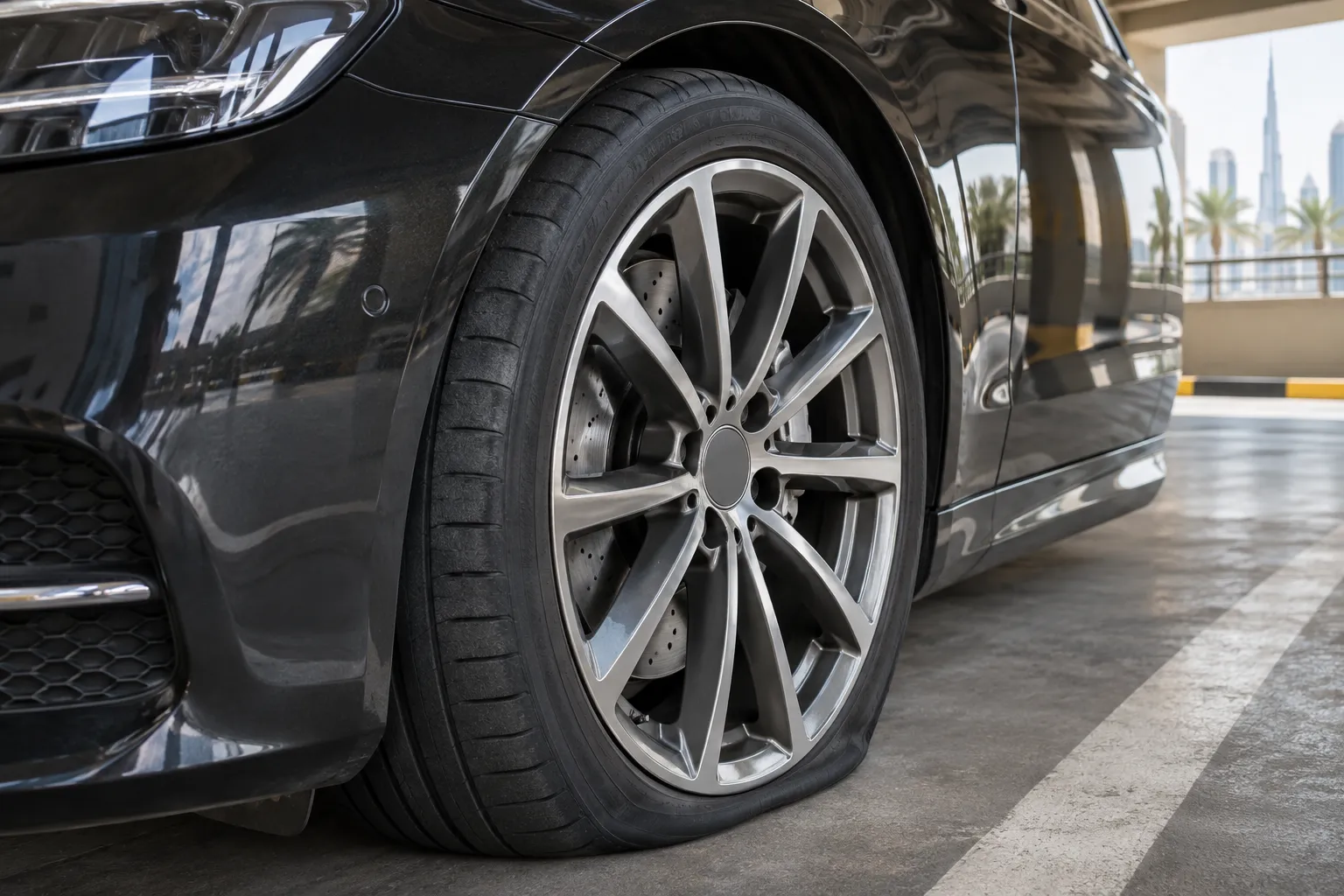
Short answer
Run-flat tyres let you keep driving for roughly 80 km at up to 80 km/h after losing pressure, which keeps you off the hard shoulder on roads like Sheikh Zayed Road. The trade-offs are a firmer ride, a higher price, fewer repair options and more limited stock in some sizes.
Key takeaways
- Run-flats typically allow around 80 km at up to 80 km/h after a puncture; your car's handbook gives the exact figure.
- Their biggest advantage in the UAE is safety: you can drive to an exit or petrol station instead of stopping on a busy shoulder.
- The downsides are a firmer ride, a higher price, limited repairability and more noise on some cars.
- A run-flat that has been driven deflated often cannot be repaired, even if the hole is small.
- Never mix run-flat and conventional tyres on the same axle, and keep your TPMS working.
Run-flat tyres let you keep driving after a puncture, typically for around 80 km at up to 80 km/h, so you can reach an exit, a petrol station or home instead of stopping on a busy hard shoulder. For UAE drivers that’s a real safety benefit. The downsides are a firmer ride, a higher price, fewer repair options, and sometimes limited stock in less common sizes. Whether they’re right for you depends on your car, where you drive, and how much the ride bothers you.
I work on run-flats nearly every day, mostly on BMWs, Minis and some Mercedes. Here’s an honest view from the van.
How run-flats work
A normal tyre needs air pressure to hold the car up. When it loses pressure, the sidewall collapses and the rim ends up crushing the rubber against the road.
Most run-flat tyres are “self-supporting”. Their sidewalls are much thicker and stiffer, reinforced with extra rubber inserts, so they can carry the weight of the car for a limited distance with no air at all. You’ll see them marked RunFlat, RFT, RSC, ROF, ZP, SSR or DSST, depending on the brand.
Because you might not feel a run-flat go down, cars fitted with them must have a working tyre pressure monitoring system. The TPMS is what tells you there’s a problem.
The pros
You don’t have to stop on the hard shoulder
This is the big one for me. I’ve attended too many flats on Sheikh Zayed Road, Al Khail Road and the E311 where people were standing a metre from traffic. With a run-flat, you slow down, move to the right lane, and drive to the next exit. My article on what to do with a flat on Sheikh Zayed Road explains why that matters so much.
Better control after a sudden loss of pressure
Because the sidewall doesn’t collapse, the car stays more stable if a tyre deflates quickly at speed. It’s not a guarantee against a blowout, but the car is easier to control.
No spare wheel needed
Cars designed for run-flats usually have no spare. That frees boot space and saves some weight. It also means no roadside wheel changes in 45°C heat.
Night and family safety
If you’re driving alone late at night, or with children, being able to keep moving to a lit, safe place is worth a lot. Several of my regular customers keep run-flats for exactly this reason.
The cons
Firmer, harsher ride
Stiff sidewalls don’t absorb bumps as well. On Dubai’s many speed bumps, expansion joints and rough service roads, you’ll feel it. Newer generations are much better than early run-flats, but the difference from a conventional tyre is still noticeable.
Higher price
Run-flats generally cost more than an equivalent conventional tyre, sometimes a lot more in larger sizes. Our run-flat tyre replacement page has current price ranges for common BMW and Mercedes sizes.
Limited repairability
This is where I disappoint people most. Many tyre makers say a run-flat can be repaired only if the puncture is in the tread area and the tyre wasn’t driven far deflated. Some say not to repair them at all. Because the stiff sidewall hides internal damage, the tyre has to come off the rim and be inspected inside. If I see crumbling rubber or a worn band on the inner sidewall, it’s finished. I explain the repair methods in plug vs patch puncture repair.
Availability
Common sizes are easy to find in Dubai. Less common sizes, or a specific approved fitment marked with a star (★) for BMW, sometimes need ordering. If you get a puncture you can’t repair, you may wait a day for the right tyre.
Heat in the UAE
A run-flat running with no air generates a lot of heat in the sidewall. The 80 km figure is usually given for moderate conditions. On a 47°C day with a loaded car, I’d stop well before that.
Pros and cons at a glance
| Run-flat | Conventional tyre | |
|---|---|---|
| Driving after puncture | Around 80 km at up to 80 km/h | Must stop immediately |
| Spare wheel | Not needed | Spare or repair kit needed |
| Ride comfort | Firmer | Softer |
| Price | Higher | Lower |
| Repair after puncture | Limited, conditions apply | Usually repairable in tread area |
| Availability | Good in common sizes, slower in others | Very wide |
| TPMS | Essential | Recommended |
A real case from Dubai Hills
In March a customer called from Dubai Hills. His BMW X5 showed a pressure warning on the way home from Jebel Ali, and he’d kept driving because “it’s a run-flat”. He’d done about 35 km at normal speed, around 100 km/h. When I took the tyre off, the screw that caused it was in the centre of the tread, perfectly repairable on a normal tyre. But the inner sidewall had a ring of grey rubber crumbs. Driving at 100 km/h on a deflated run-flat for that distance had cooked it. He needed a new tyre.
The tyre did its job. It got him home safely. But staying under 80 km/h and calling us from the first petrol station would probably have saved the tyre. How speed and distance affect any tyre is covered in can you drive on a flat tyre.
Should you switch to conventional tyres?
Some BMW owners swap run-flats for conventional tyres for a softer ride. It’s possible, but think about it first:
- You need a backup. The car has no spare. Carry a repair kit and compressor, or a space-saver if it fits.
- Change all four. Never mix run-flats and conventional tyres on the same axle, and ideally not on the same car.
- Handling changes. The suspension was tuned for run-flats. Most people find the result fine, but it feels different.
- Hard shoulder risk returns. A flat now means stopping wherever you are.
For drivers who do lots of night motorway driving, I usually suggest staying with run-flats. For those mostly doing short city trips who hate the ride, conventional tyres plus a good kit can make sense.
Brands worth looking at
Bridgestone and Pirelli supply many factory run-flat fitments, and Michelin, Continental, Goodyear and Dunlop all have strong ranges. Look for the approval mark for your car, and check the DOT date like any other tyre.
Looking after run-flats
- Keep the TPMS working. A faulty sensor on a run-flat car is a real safety problem. Our TPMS sensor service can test and replace sensors on site.
- Check pressures cold every two weeks. You won’t see a low run-flat by eye.
- After any warning, slow down to 80 km/h or less, and get off the main road quickly.
- Get alignment checked if you hit a kerb or pothole. Stiff sidewalls pass more of the impact to the wheel and suspension.
When to call us
If your run-flat warning comes on, slow down, find a safe place off the main road, and contact us through the contact page. We’ll bring the right tyre in your size where possible, inspect the damaged one from inside, and tell you straight whether it can be saved.
Frequently asked questions
How far can you drive on a run-flat tyre in Dubai?
Most run-flats are designed for about 80 km at up to 80 km/h after a total loss of pressure, but the figure varies with load and the tyre model. In summer heat it is wise to stop sooner, at the first safe exit or petrol station.
Can run-flat tyres be repaired?
Some can, if the hole is in the tread area and the tyre was not driven far while deflated. Many manufacturers place strict conditions on it, so the tyre must be removed and inspected from the inside first.
Can I replace run-flats with normal tyres?
Yes, if the sizes and ratings match, but you then need a spare wheel or a repair kit because the car will not have one. Change all four, and be aware ride and handling will feel different.
Why are run-flat tyres more expensive?
Their reinforced sidewalls use more material and more complex construction, and they are made in smaller volumes. That pushes up both the purchase price and, sometimes, the fitting cost.
Keep reading
Stuck with a puncture right now?
Send your location on WhatsApp. A technician confirms the price and heads out, usually within 30–45 minutes in central Dubai.