Tyre Pressure
TPMS Warning Light: What It Means and What to Do
Short answer
A steady TPMS light means at least one tyre is significantly under-inflated, so check all four pressures as soon as it's safe. If the light flashes for about a minute and then stays on, the system itself has a fault, usually a dead sensor battery or a missing sensor.
Key takeaways
- Steady light: low pressure in one or more tyres. Check with a gauge and inflate to the door placard figure.
- Flashing then steady: a system fault, often a sensor with a flat battery.
- Sensor batteries usually last around 5 to 10 years and can't be replaced on their own in most designs.
- A light that comes on in the morning and goes off after driving usually means pressures are borderline low.
- Never ignore a steady light on the highway; a slow puncture can become a flat quickly in heat.
A TPMS warning light tells you one of two things. If it comes on and stays on, at least one tyre is significantly below its correct pressure and you should check all four with a gauge as soon as it’s safe. If it flashes for around a minute when you start the car and then stays on, the tyre pressure monitoring system itself has a fault, most often a sensor with a dead battery. The symbol is usually a horseshoe shape with an exclamation mark in the middle.
I’m Hassan Faaz. I’ve been working on tyres in the UAE for eight years, and TPMS lights account for a big share of the calls I get on summer mornings. Here’s how to read the light and what to do about it.
How TPMS works
There are two kinds of system.
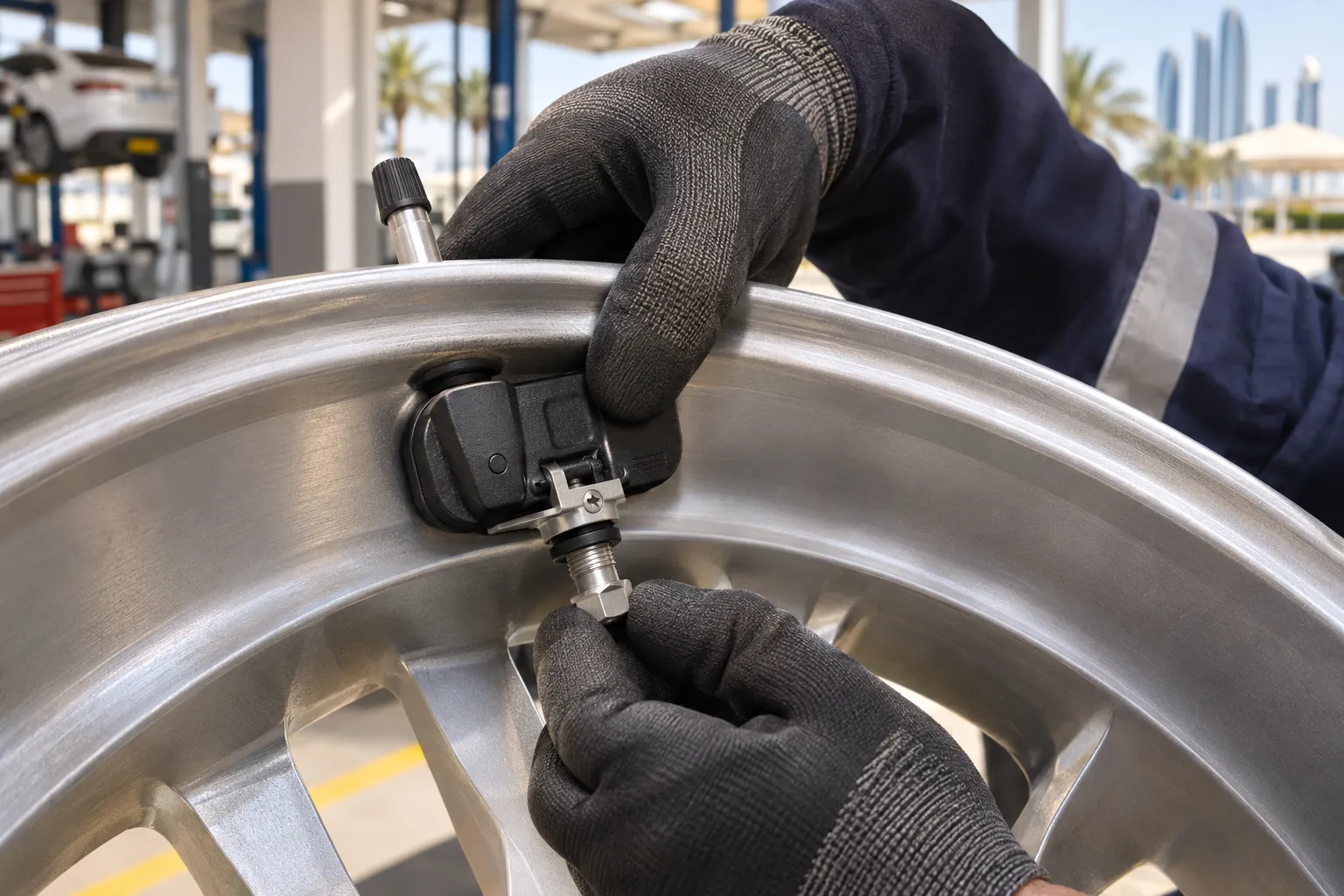
Direct TPMS uses a sensor inside each wheel, usually built into the back of the valve stem. It measures the actual pressure (and often temperature) and sends it by radio to the car. Many cars show individual pressures for each wheel on the dashboard. Most Toyota, Lexus, Nissan, Mercedes-Benz, BMW and Hyundai models sold in the UAE use direct sensors.
Indirect TPMS has no sensors in the wheels. It uses the ABS wheel-speed sensors to detect when one tyre is turning faster than the others, which happens when it loses pressure and its diameter shrinks. It’s cheaper, but it can’t tell you which tyre is low, and it doesn’t catch all four tyres losing pressure together.
Steady light vs flashing light
| What you see | What it usually means | What to do |
|---|---|---|
| Steady light, comes on while driving | One or more tyres losing pressure | Slow down, find a safe place, check pressures |
| Steady light at start-up, goes off after driving | Pressures borderline low, rise as tyres warm | Top up all four to placard pressure when cold |
| Flashes about 60–90 seconds, then steady | System fault: dead sensor, missing sensor or receiver problem | Book a sensor check |
| Light plus a “check TPMS” message after tyre work | Sensor not registered or relearn needed | Relearn with a tool |
| Light plus visibly flat tyre or pulling | Puncture or fast leak | Stop safely, fit spare or call for help |
The flashing-then-steady pattern comes from the US standard most manufacturers follow, so it’s very consistent across makes. Your handbook will confirm it for your car.
Why the light comes on in the UAE
Morning cold, afternoon heat
The most common cause I see is a light that appears at 6 am in a basement car park and disappears by the time the driver reaches the office. Pressure drops as temperature falls. A tyre that’s slightly under-inflated at 40°C in the afternoon can fall below the warning threshold in a cool, air-conditioned car park. In winter, when mornings in Dubai and Abu Dhabi drop to the mid-teens, this happens even more.
The fix is simple: set the correct pressure when the tyres are cold. My guide to the correct tyre pressure for UAE summer explains how.
Slow punctures
Screws and nails from construction sites are everywhere in growing areas. A screw in the tread can let air out over days. The TPMS light is often the first warning. We repair these on the spot with a plug-patch combination through our puncture repair service, as long as the damage is in the repairable tread area and no larger than 6 mm.
Leaking valve or corroded sensor
Aluminium sensor valve stems can corrode where they meet the rim, especially on cars that are washed often or parked near the coast in places like Al Mamzar or Abu Dhabi corniche. The seal fails and the tyre slowly leaks around the valve. A new seal kit, nut and valve core usually solve it.
Dead sensor battery
Sensor batteries are sealed inside the unit. They typically last around 5 to 10 years, depending on the design and how much the car is driven. Heat shortens battery life. When one dies, the system flashes the warning. In most cases the whole sensor has to be replaced.
After tyre work
If someone fitted new tyres, rotated the wheels or installed a winter or desert set without sensors, the system may not recognise the new arrangement. Some cars relearn automatically after a short drive. Others need a scan tool to register sensor IDs and positions.
What to do when the light comes on while driving
- Don’t brake hard or swerve. Ease off the accelerator.
- Look at individual pressures if your car shows them.
- Get to a safe place. A petrol station is ideal. On Sheikh Zayed Road or Emirates Road, take the next exit rather than stopping on the hard shoulder, unless the tyre is clearly flat.
- Check all four with a gauge, not just the one that looks low.
- Inflate to the door placard figure, not the maximum on the sidewall.
- Watch the pressure over the next day. If one tyre drops again, there’s a leak.
- If the tyre is flat or damaged, don’t drive on it. Fit the spare or call us. If you’re in a dangerous spot, call 999.
Can you ignore it?
No. A steady light means a tyre is low enough to raise heat and flexing in the sidewall. In UAE summer, on asphalt at 60°C or more, that’s exactly the condition that leads to tread separation and blowouts. A flashing light is less urgent, but it means the system can’t warn you of a real pressure loss, so get it fixed rather than covering it up.
Sensor replacement and costs
Our TPMS sensor service starts from AED 149 per sensor. What moves the final price:
- Car make and model. Some European cars, including several Mercedes-Benz models, use specific sensors.
- OE or programmable aftermarket sensor. Programmable sensors are cloned or coded to match your car.
- Relearn requirement. Some cars need a full relearn procedure.
- Location and time of the callout.
A tip from the job: if one sensor dies at seven years old, the others are often close behind. When you’re replacing tyres anyway, it can make sense to replace all sensors at once, since the tyres are already off the rims.
Does nitrogen help?
Nitrogen holds pressure longer, so you may see the light less often. It doesn’t affect how sensors work. I’ve written more about it in nitrogen vs air in tyres.
Common myths about the TPMS light
“The light means my tyre is flat.” Not always. Most systems warn when a tyre is about 25% below its set pressure, which on a 35 psi tyre is around 26 psi. The tyre may look normal.
“If it goes off after a drive, there’s no problem.” The tyres warmed up and the pressure rose above the threshold. They’re still low when cold. Top them up.
“I can unplug the system.” Some people ask us to disable the light. We won’t, and on many cars it isn’t possible without causing other warnings. The system exists because people don’t notice slow pressure loss.
“Indirect TPMS catches everything.” It can miss all four tyres losing pressure slowly together, which is exactly what happens over a few weeks in hot weather.
When to call us
If the light stays on after you’ve set the correct pressures, or a tyre keeps losing air, book a check. We find the leak, repair the tyre or valve, test each sensor and relearn the system at your home or office. If you’re searching for tyre puncture repair near me with a light on the dash, contact us and tell us your car model so we bring the right sensor.
Frequently asked questions
Can I drive with the TPMS light on?
You can drive slowly to a safe place or petrol station to check pressures, but don't continue at highway speed until you know why it's on. If a tyre is visibly low or the car pulls, stop and change to the spare or call for help.
Why is my tyre pressure light on but the tyres look fine?
Tyres can lose 25% of their pressure without looking flat, especially low-profile tyres. Use a gauge. If the pressures are correct and the light still shows, a sensor may be faulty or the system needs a reset.
How much does a TPMS sensor cost in Dubai?
Our TPMS sensor service starts from AED 149 per sensor. The price depends on the car make, whether it's an OE or programmable aftermarket sensor, and whether a relearn is needed.
How do I reset the TPMS light?
Inflate all tyres to the correct pressure and drive for 10 to 20 minutes; many cars clear the light on their own. Some have a reset button or menu, and some need a scan tool to relearn the sensors.
Does nitrogen affect TPMS sensors?
No. Sensors measure pressure, not gas type, and work normally with nitrogen. Nitrogen's dryness may even help reduce corrosion on the valve over time.
Keep reading
Stuck with a puncture right now?
Send your location on WhatsApp. A technician confirms the price and heads out, usually within 30–45 minutes in central Dubai.