Tyre Pressure
Nitrogen vs Air in Tyres: Worth It in the UAE?
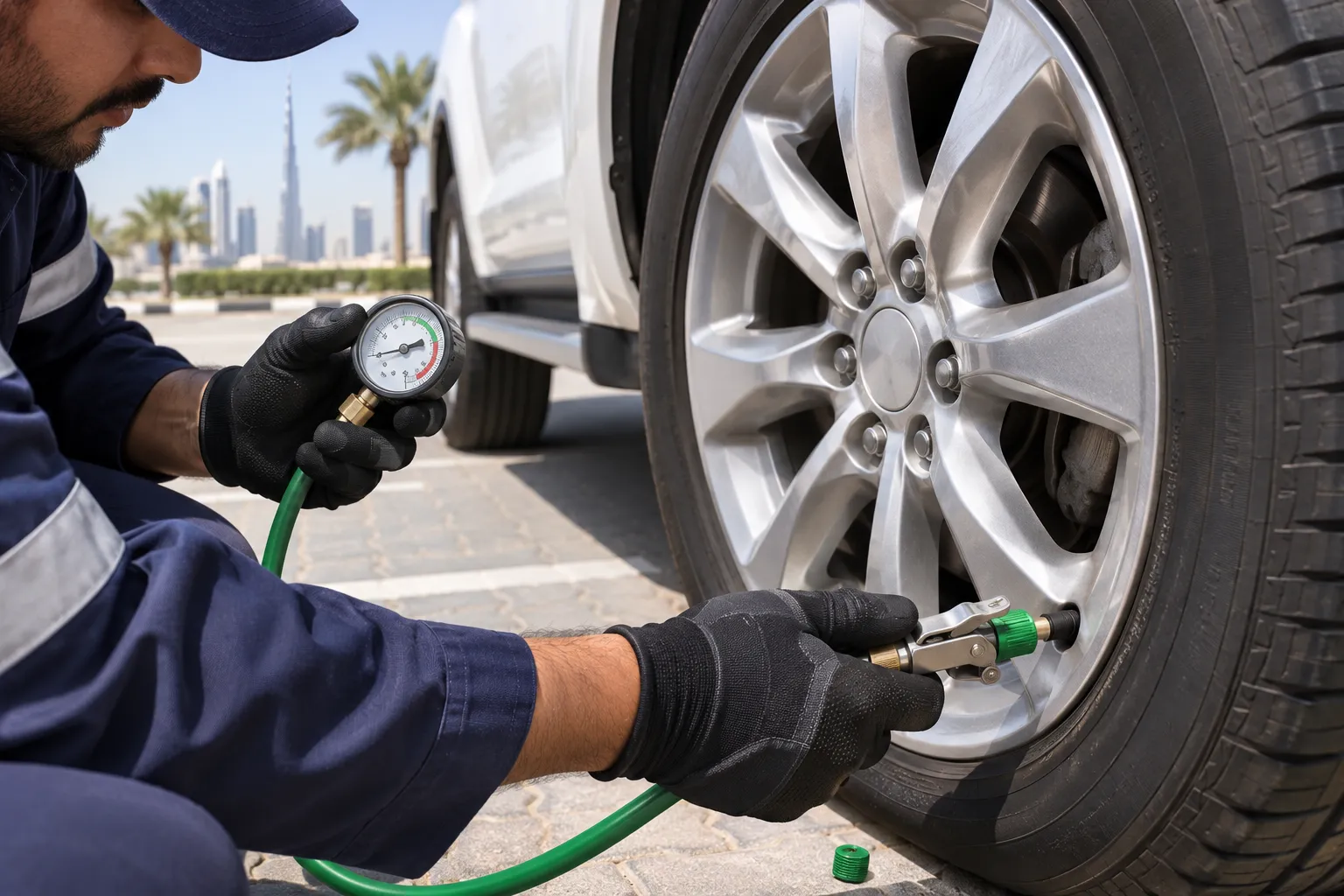
Short answer
Nitrogen is worth it in the UAE if you rarely check your pressures, because it leaks out of rubber more slowly and carries no moisture, so pressure stays steadier in the heat. At AED 10 per tyre it is cheap, but it does not replace a monthly pressure check.
Key takeaways
- Normal air is already about 78% nitrogen; a nitrogen fill raises that to roughly 93–95% and removes most of the oxygen and moisture.
- Nitrogen seeps through tyre rubber more slowly than oxygen, so pressure drops more gradually between checks.
- Dry gas means smaller pressure swings between a cool morning and 65°C asphalt at 3 pm.
- It does not stop punctures, fix a leaking valve or make an old tyre safe.
- Topping up a nitrogen tyre with ordinary air is safe; you just dilute the benefit.
Nitrogen is worth paying for in the UAE if you are the kind of driver who checks tyre pressure only when the warning light comes on. It leaks out of the tyre more slowly than ordinary compressed air and it carries almost no moisture, so your pressures stay closer to the correct figure through a Dubai summer. If you already check your tyres every couple of weeks with a decent gauge, the gain is small. At AED 10 per tyre it is cheap insurance, not a miracle.
I’m Hassan Faaz. I’ve been fitting, repairing and inflating tyres in the UAE for eight years, and nitrogen is one of the questions I get asked most at petrol stations and in basement car parks. Here is what I tell customers, without the sales talk.
What is actually inside your tyre
The air you breathe is roughly 78% nitrogen, 21% oxygen and a small amount of argon, carbon dioxide and water vapour. So when someone says “I have air in my tyres”, they already have mostly nitrogen.
A nitrogen fill from a membrane generator, like the one in our vans, raises the nitrogen content to around 93–95%. To get close to that figure in a tyre that already has air in it, we deflate and refill it more than once. That process is called purging. A single top-up on a tyre full of air gives you a mix, not pure nitrogen.
The two things nitrogen removes are oxygen and moisture. Both matter more in the UAE than in cooler countries.
Why nitrogen holds pressure longer
Rubber is not perfectly airtight. Gas molecules slowly pass through the tyre’s inner liner and sidewall. Oxygen molecules make this journey faster than nitrogen molecules, so an air-filled tyre loses its oxygen first and slowly drops in pressure.
With mostly nitrogen inside, that natural seepage is slower. In practice, I see nitrogen tyres on fleet vehicles that come back after a month still close to their set pressure, while the air-filled tyres on the same model have dropped a few psi. A few psi does not sound like much, but on a 35 psi tyre it is enough to raise sidewall flexing and heat at highway speed.
The heat question: what changes and what doesn’t
There is a myth that nitrogen does not expand with heat. It does. Every gas follows the same basic law: as temperature rises, pressure rises. A tyre filled cold at 32 psi in a basement at 6 am will read higher after an hour on the E11 in July, whatever is inside it.
The real difference is moisture. Workshop compressors, especially the coin machines at some petrol stations, push humid air into the tyre. Water vapour changes pressure more unpredictably as it heats and cools, and it can sit inside the tyre and around the valve. Dry nitrogen gives you smaller, more predictable swings between a cool morning and asphalt that can hit 60–70°C in the afternoon.
| Factor | Compressed air | Nitrogen (93–95%) |
|---|---|---|
| Pressure loss through rubber | Faster, oxygen escapes first | Slower |
| Moisture content | Varies, often humid | Very dry |
| Pressure rise with heat | Yes, less predictable | Yes, more predictable |
| Oxidation of inner liner and wheel | Some, over years | Very little |
| Cost | Free or AED 1–2 at a station | From AED 10 per tyre |
| Availability for top-ups | Every ADNOC, ENOC and Emarat station | Fewer places |
Where nitrogen makes a real difference
From what I see on the job, nitrogen pays off most for:
- Drivers who don’t check pressure. If your routine is “whenever I remember”, slower leakage protects you from yourself.
- Cars that sit for weeks. A car parked in Dubai over the summer while the family travels often comes back with soft tyres. Nitrogen slows that.
- Long highway runs. Regular Dubai to Abu Dhabi commutes on the E11, or weekend drives to Hatta, keep tyres hot for long periods. Stable pressure keeps heat build-up under control.
- Fleets and delivery vans. Fewer pressure checks across many vehicles is a real saving in time.
- Cars with alloy wheels you want to keep clean inside. Less moisture means less corrosion around the bead seat and valve over the years.
Where it makes no difference at all
Nitrogen will not fix a slow puncture. Last month I had a customer in JLT who had paid for nitrogen at a dealer and was annoyed that his tyre kept going soft. The cause was a screw in the shoulder. Gas type has nothing to do with it. That needed a proper plug-patch puncture repair, not another refill.
It also won’t fix:
- A corroded or leaking valve core
- A bent rim that leaks at the bead
- A faulty or dead TPMS sensor (see our TPMS sensor service)
- A tyre that is too old, cracked or bulging
I say this because I sometimes meet drivers who think nitrogen makes them safe on a seven-year-old tyre. It doesn’t. Age and damage are separate problems, and they are behind most of the blowouts I attend, as I explain in my piece on why tyres burst in UAE summer.
Topping up: green caps and petrol stations
Many nitrogen-filled tyres have green valve caps so the next technician knows what’s inside. If you are low and the nearest option is a normal air machine at a petrol station, use it. Running on low pressure is far more dangerous than diluting your nitrogen. Mixing the two gases is completely safe.
Next time you book a nitrogen fill, we can purge the tyre again and bring the purity back up.
How to get the most from a nitrogen fill
- Set the pressure cold. Use the figure on the door-jamb placard, not the maximum printed on the sidewall. My guide to the correct tyre pressure for UAE summer explains why the placard figure is the starting point.
- Fill all four, plus the spare if it’s full size. A nitrogen spare that holds pressure for a year is worth having.
- Still check monthly. Use a gauge, not a kick. A cheap digital gauge from any ADNOC or ENOC shop is fine.
- Replace valve cores when fitting new tyres. A fresh core and cap are cheap and stop slow leaks at the valve.
What a nitrogen fill costs with us
Our nitrogen inflation service starts from AED 10 per tyre. What moves the final price:
- First fill with purging takes longer than a top-up.
- Booking nitrogen on its own as a callout costs more than adding it to a rotation, balancing or puncture job we’re already doing.
- Larger SUV and 4x4 tyres take more gas and time.
If you want the details on where we fill and how, our page on nitrogen tyre filling in Dubai covers the process.
My honest verdict
For most UAE drivers, nitrogen is a sensible, low-cost extra, especially if you drive long distances or leave the car parked for weeks. It is not a substitute for checking pressure, rotating tyres and replacing them on time. If you are spending money on tyre care and have to choose, buy a good digital gauge first and nitrogen second.
When to call us
Book a nitrogen fill when the tyres are cold, so early morning or after the car has been parked for a few hours. We come to your home or office anywhere in Dubai, Sharjah and Abu Dhabi. If a tyre keeps losing pressure even after a nitrogen fill, don’t keep topping it up. There’s a leak somewhere, and we can find it on the spot. Contact us and tell us your car and tyre size so the technician brings the right kit.
Frequently asked questions
Is nitrogen better than air for tyres in Dubai?
Slightly, yes. Nitrogen holds pressure longer and is dry, which helps in UAE heat. The difference is small compared with simply checking your pressure every month with a good gauge.
How much does nitrogen tyre filling cost in Dubai?
Our nitrogen inflation starts from AED 10 per tyre. The final price depends on whether it is a first fill with purging or a top-up, and whether it is added to another mobile job or booked as a callout on its own.
Can I mix nitrogen and normal air in my tyres?
Yes. Mixing is completely safe. Adding air simply lowers the nitrogen percentage, so the tyre will behave more like an air-filled tyre until it is purged and refilled.
Does nitrogen stop tyres bursting in summer?
No. Bursts in summer usually come from low pressure, overloading, old rubber or impact damage. Nitrogen helps keep pressure stable, but it will not save a tyre that is already damaged or past its age.
How often should I check nitrogen-filled tyres?
Check them monthly, the same as air. They lose pressure more slowly, but punctures and valve leaks still happen, and only a gauge will tell you.
Keep reading
Stuck with a puncture right now?
Send your location on WhatsApp. A technician confirms the price and heads out, usually within 30–45 minutes in central Dubai.