Punctures & Repairs
Tyre Sealant and Repair Kits: Do They Work?
Short answer
Tyre sealant kits do work for small punctures in the tread, typically up to about 4 to 6 mm, and they can get you to a tyre shop at reduced speed. They won't seal sidewall damage, large cuts or a tyre that's come off the rim, and the tyre still needs a proper repair afterwards.
Key takeaways
- Sealant kits are a temporary fix for small tread punctures, not a permanent repair.
- They don't work on sidewall or shoulder damage, cuts, or a tyre off its bead.
- Most kits limit you to around 80 km/h and a short distance; check the label.
- Sealant can expire, and UAE heat shortens its shelf life; check the date on the bottle.
- Tell the technician you used sealant, so they can clean the tyre and check the TPMS sensor.
Yes, tyre sealant and repair kits work, within limits. For a small puncture in the tread, from a nail or screw up to about 4 to 6 mm across, a sealant kit can seal the hole well enough to get you to a tyre shop at reduced speed. They won’t fix a cut or puncture in the sidewall or shoulder, a large gash, or a tyre that has come off the rim. And they’re always temporary: the tyre still needs a proper repair from the inside afterwards.
I’m Hassan Faaz, a tyre technician in the UAE for eight years. More and more new cars arrive here without a spare, just a small compressor and a bottle of sealant under the boot floor. I deal with the results of those kits most weeks, good and bad.
What’s in a typical kit
Most factory kits have two parts:
- A bottle of liquid sealant, usually a latex-based formula with fibres or particles.
- A 12V compressor that plugs into the car’s power socket, with a pressure gauge and hose.
You connect the bottle to the valve, the compressor pushes the sealant into the tyre, then inflates it. As you drive, the sealant spreads around the inside and is forced into the hole, where it plugs it.
There are also aerosol cans that combine sealant and propellant in one, and string plug kits, which work differently. I’ll cover both below.
When sealant works
From what I’ve seen, sealant has a good chance of working when:
- The puncture is in the central tread area, not near the shoulder.
- The hole is small, from a nail, screw or small piece of wire.
- The object is still in the tyre or has just come out.
- The tyre hasn’t been driven flat for any distance.
- The sealant is in date and was stored properly.
A customer in Al Barsha last spring picked up a screw on the way to work, used her car’s factory kit in the office car park, and drove 8 km to her home at gentle speed. When we arrived, the tyre was holding pressure. We removed the tyre, cleaned it, and fitted a plug-patch repair. That’s exactly how these kits are meant to work.
When sealant fails
| Damage | Will sealant work? | Why |
|---|---|---|
| Nail or screw in tread, under ~6 mm | Usually | Small hole, flexible area seals well |
| Puncture near the shoulder | Unreliable | Area flexes too much |
| Sidewall puncture or cut | No | Sidewall can’t be sealed or safely repaired |
| Gash or tear over ~6 mm | No | Too large to bridge |
| Tyre off the bead | No | Air escapes around the rim |
| Damaged or cracked rim | No | Leak isn’t in the tyre |
| Tyre driven flat | Possibly seals, but tyre may be damaged inside | Structural damage hidden |
Sidewall damage is the one people try hardest to save. Unfortunately it can’t be sealed reliably, and even if sealant stops the leak, the damage is in the part of the tyre that flexes most. The tyre needs replacing.
The UAE problem: heat and shelf life
Sealant has an expiry date, usually printed on the bottle. In cooler countries that date might be several years out. In a UAE boot that reaches very high temperatures in summer, the latex can thicken, separate or dry out earlier.
I’ve opened factory kits on four- and five-year-old cars where the sealant was a lumpy paste. It wouldn’t flow through the hose. If your car is a few years old, check the date now, not on the hard shoulder of Emirates Road. Replacement bottles are available from dealers and parts shops.
How to use a kit correctly
- Get to a safe place. Off the main carriageway, hazards on. If you’re on a fast road in a dangerous spot, stand behind the barrier and call 999.
- Leave the object in the tyre if it’s still there.
- Read the instructions on the kit. Each one is slightly different.
- Connect and inject the sealant, then inflate to the pressure on your door placard.
- Drive immediately for a few kilometres at moderate speed to spread the sealant.
- Stop and check the pressure. If it has dropped a lot, the hole is too large. Don’t keep going.
- Stick to the speed limit on the kit, usually around 80 km/h, and get the tyre repaired soon.
- Put the speed sticker on the dashboard so you remember.
What happens to the tyre afterwards
This is where the trouble starts for some drivers. Sealant isn’t a repair. It sits loose inside the tyre and around the rim.
When we repair a tyre after sealant, we:
- Remove the tyre from the rim
- Clean out all the sealant from the tyre and wheel
- Inspect the inner liner for damage from running low
- Clean and test the TPMS sensor
- Fit a plug-patch combination repair from the inside, which is the correct method for a tread puncture. I explain why in my plug vs patch post.
Some shops refuse sealant-filled tyres because of the cleaning time. We don’t, but please tell the technician you used it. It changes how we approach the job.
TPMS sensors
Older latex sealants could block the small hole in a TPMS sensor that reads the pressure. Many current kits claim to be TPMS-safe, and in my experience they’re much better. Still, I clean every sensor after sealant use, and occasionally one needs replacing. If the warning light won’t clear afterwards, our TPMS sensor service can test and replace it.
Plug kits and aerosol cans
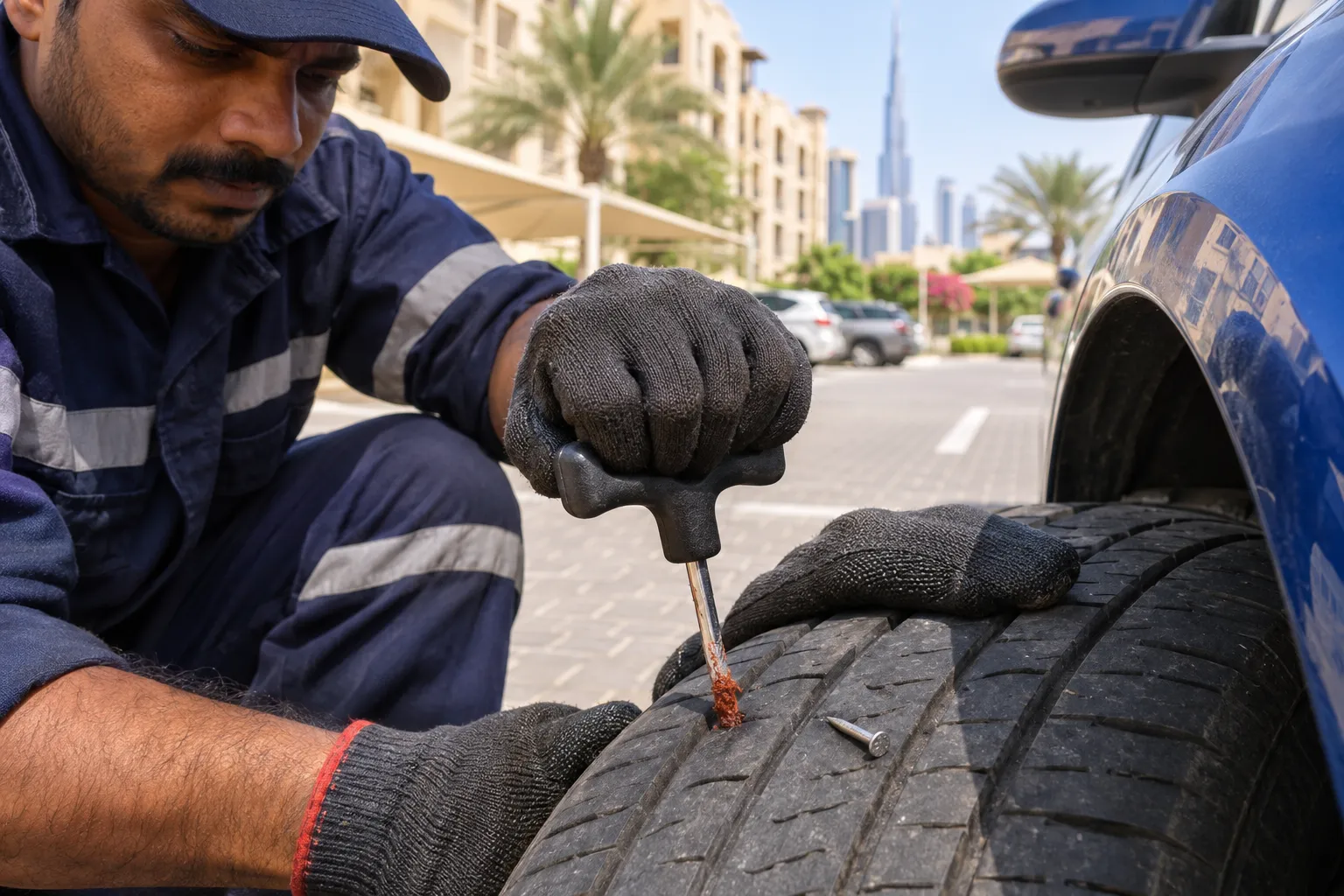
String plug kits use a sticky rubber strip pushed into the hole with a reamer and insertion tool. They work well on nails and screws in the tread, leave no mess inside, and are popular with off-road drivers. They need some technique, and you need a compressor to reinflate. They’re still a temporary roadside fix, not a substitute for a proper inside repair.
Aerosol cans are the cheapest option and the least reliable in my experience. They often don’t have enough volume to inflate a large SUV tyre properly.
Sealant kit or spare tyre?
A sealant kit saves weight and boot space, which is why manufacturers fit them. But it can’t help with sidewall damage, which is common here because of kerbs and debris. If your car came with only a kit, consider adding a space saver if one is approved for your car. I compare the options in space-saver vs full-size spare.
What a proper repair costs
Our puncture repair service starts from AED 49 per tyre. The final price depends on the tyre size, whether sealant needs cleaning out, whether the TPMS sensor needs attention, and your location and time. For more detail on pricing, see puncture repair cost in Dubai.
When to call us
If you’ve used a sealant kit, book a proper repair within a day, and ideally before driving much further. If the kit didn’t hold, or the damage is on the sidewall, don’t try again. Stay safe and let us come to you anywhere in Dubai, Sharjah or Abu Dhabi. Contact us with your location and tyre size, and we’ll repair or replace the tyre where the car is parked.
Frequently asked questions
Can a tyre be repaired after using sealant?
Often yes, if the puncture is in the repairable tread area and the tyre wasn't driven flat. The technician has to remove the tyre, clean out the sealant and inspect the inside before fitting a plug-patch repair.
Does tyre sealant damage TPMS sensors?
It can. Some sealants clog the sensor's pressure port or leave residue on it. Many modern kits are labelled TPMS-safe, but the sensor should still be cleaned and checked after use.
How long does tyre sealant last in a tyre?
It's designed to last long enough to reach a tyre shop, not for weeks. Get the tyre properly repaired within a day or two and within the distance printed on the kit.
Do tyre sealant kits expire?
Yes. Most bottles have an expiry date printed on them, often a few years from manufacture. In a hot UAE boot the sealant can thicken or separate sooner, so replace it on or before the date.
Are plug kits better than sealant?
For a nail or screw in the tread, a string plug kit can seal more reliably than liquid sealant and doesn't leave residue. It's still a temporary fix, and it needs some skill and a way to reinflate the tyre.
Keep reading
Stuck with a puncture right now?
Send your location on WhatsApp. A technician confirms the price and heads out, usually within 30–45 minutes in central Dubai.